RISK: Design Vulnerability

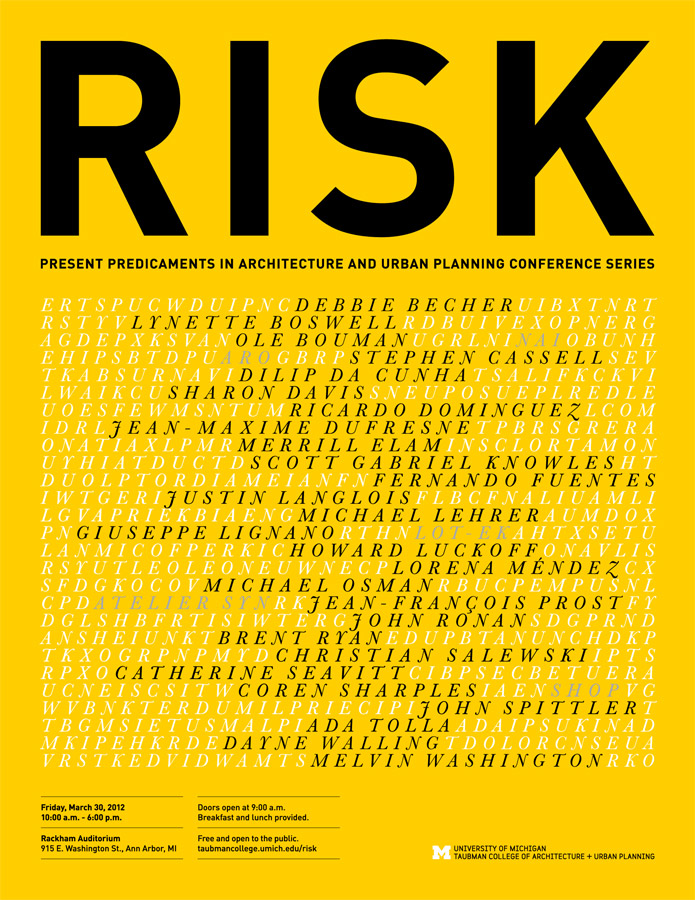
RISK, a conference that highlights present predicaments in architecture and urban planning, will explore the intersection between entrepreneurship and practice, taking risks in design, coopting strategies from other disciplines to advance architecture and planning, and in general not being afraid of change.

A dynamic group of speakers will engage the topic in 15-minute presentations, followed by faculty responses to provide commentary and provocations on themes such as personal risk; professional risk; environmental risk; risk of investing in the central city; and design as risk.

Details

March 30, 2012
Rackham Auditorium, 915 East Washington Street, Ann Arbor, MI 48109
Time: 10 AM – 6:30 PM, Doors Open at 9 AM

Justin is presenting on the Design Vulnerability panel, moderated by Walter B. Sanders Fellow, Etienne Turpin, alongside these incredible speakers:

Ricardo Dominguez, Associate Professor, UCSD; Co-Founder, Electronic Disturbance Theater

Jean-Maxime Dufresne & Jean-François Prost, Principals, SYN – Atelier d’exploration urbaine

Fernando Fuentes & Lorena Méndez, Co-founders, La Lleca Colectiva

Here’s the brief for the panel:

From the perspective of design research, the laboratory is a model for investigating urban scenography, interstitial space, transient icons, and the political economies which shape architecture and the city. The lab is not, in this model, the hygienic space portioned from the world to afford a distanced observation; the lab is instead a platform for embedded forms of inquiry, intervention, speculation, and experimentation. These precarious forms of practice are affirmed through design strategies that embolden our experiences of vulnerability at the level of the city, the social, and the ecological. These practices do not attempt to erase vulnerability through design but instead leverage design research and performative experimentation by collaborating with and among various vulnerabilities. The panel considers how practices of accumulating vulnerability offer new models of courage and conviction for post-heroic architecture and design.

In Store: Unto Caesar

The week almost escaped without getting a new instalment of In Store posted. So, if you haven’t already seen it on the In Store site, here’s the latest:

Downtown Windsor is framed by two landmarks: the Ambassador Bridge in the West, and the casino in the east. They are sights to behold, especially at night. Last week we looked at the bridge (and in fact we will return to it by way of Indian Road in a later film). So it’s only right that we now turn to the casino.

This week we follow Robin Fitzsimons as she trains to become the ultimate gambler, and then faces off against the mighty Caesars Windsor, icon of Windsor’s tourist industry.

Hi, 5 with Sandy Noble

About the Hi, 5 Interview Series

Hi, 5 (5 Questions) is a web-only interview series which presents five questions to artists, activists, and creative thinkers alike.  The project acts as an educational device which allows us to gain insight into the narratives that define successful individuals.  We are interested in the motivations behind ambitious ideas and how these individuals chart personal change in relation to their surroundings.

About Sandy Noble

Sandy Noble is a maker, a designer and a programmer. Sandy’s website is called Up To Much. Not home-spun exactly, but conceptually simple pieces, usually with some kind of particular conceit that makes them look more complex than they are, or complex, but with an elegant appearance: a series of elaborations on a basic concept.

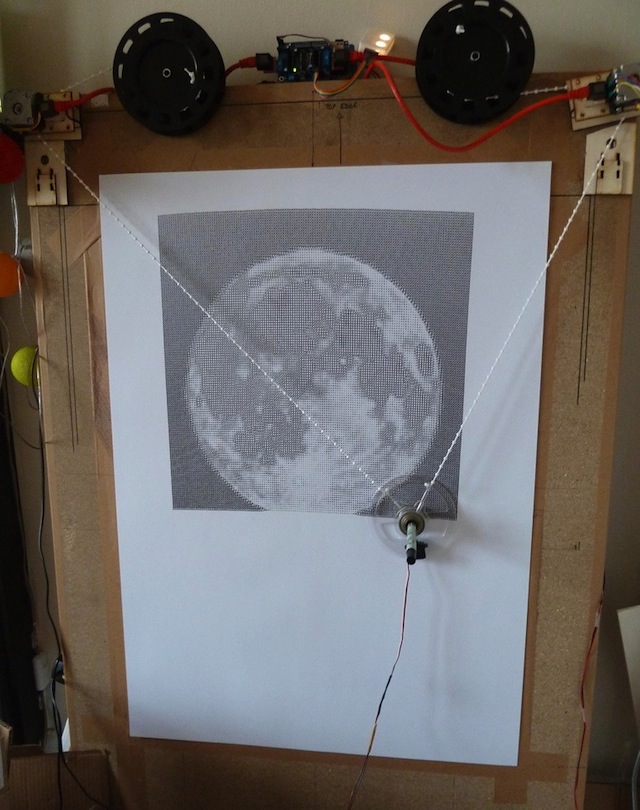
Sandy Noble - Polargraph Machine

Sandy Noble

February 22/2012

If you had to describe your current self to a 16-year-old you, what would you say?

Just like you, but all the the things that made you a bit odd then, are the things that make me valuable now.

Could you describe an evolution in your work or way of thinking?

I’m very attached to how things work, rather than what they look like, or probably even what they do.  When I was a kid I made lots of plastic models, and enjoyed making some much more than others.  Some kits assembled beautifully, with lots of sub-assemblies, tabs, interlocking pieces.  Others left much more up to the builder’s skill to judge where a part should be stuck.  I never painted them – that’s the boring bit – where’s the fun?

I’m still very technically-focused, and working on projects where I am the designer and also the implementer suits that focus, it’s absolutely appropriate.  But it can be a handicap in the ideation phase of a project so I needed to learn to know when to switch it off. Learning about the stagey, iterative nature of the design process taught me when I should be thinking technically and when I should be thinking free-form.

I’m not very good at the free-form stuff, that’s the problem, and it’s partly a skills issue – I just never got very good at sketching fast, representation.  Everything I do I tend to want to boil it down to a series of diagrams, and just hold the gestalt of it in my head.  This skills problem really does flavour what I get around to doing – if it’s hard to express, it just doesn’t get done, or at least, it doesn’t get put down on paper.  It just floats around in my head until it crystalizes enough to be diagrammed, and that’s unfortunately a good way to lose inspiration, and can be discouraging when I look in my sketchbook and see the same old thing page after page, rather than all the amazing ideas I think I’m having but can’t express very clearly.

Generally my work is very tools-led.  I like using the tools much more than I like having the finished object.  Design is nice because design itself is a great big tool that can be used to make anything. So I made a desk once, and it works great as a desk, but my favourite thing about it is the work I did designing it.

So my art is entirely a product of the machine – the machine is the real piece of work, the drawings that come from it are only the proofs.  The polargraph machine is interesting too because it’s very very technical.  It’s programmed with a certain behaviour, and that’s where I see the art in it, that’s where the magic is.  Which is nice, because as a professional software developer, it’s the exact same art that I use during my day job.

Are there any people who have been instrumental in the development of your way of thinking and viewing the world?

Other than my immediate family, very few.  My mom and dad are very practical people who would be happy to fix and make things from scratch.  They tell me “I’ll show you how, then you can do it yourself” and in many cases this the result of being tired of endlessly doing stuff for other people, but in other cases it is a genuine wish to share something they find marvelous and engaging.  Their house has a gate at the back with this carved wooden handle on the back, just a plain one, functional.  And it’d been carved and polished up and sat there every day for forty years.  I remember being amazed and proud when only fairly recently I realized my dad had made it from a block of wood rather than just buying one from a shop.  It was clearly the product of some love, some enjoyment of the process. Because actually it was pretty unnecessary in that place.  I was horrified when they threw that door away to get a new one, handle and all, all replaced by off-the-shelf hardware.  They are very unsentimental like that.

I suppose I am too, which is why I don’t like things which are purely decorative.  Even if a photograph or a painting looks beautiful, I’m more interested in knowing what technical aspects create that feeling, or how it was made than just letting it wash over me, and if I don’t know that, I can’t really decide if I like it or not.

How do your political beliefs inform or fuel your work as an artist?

I feel that if people take from others, they should give to others. And, paying forward rather than paying back.  People would like me to claim that I invented the polargraph machine, or that I am a trail blazer of some sort for using 3d printing in jewellry, and are a little dismayed when I tell them these things are just the most recent development of very commonplace technology – there is no high-tech here, no genius, no special insight, only the will to experiment for it’s own sake, and the will to publicly invest in something.  That in itself, like art, is quite attractive and will get people’s attention.

So even though I’m a little wary of just giving all my hard work away, I realize I must because I owe it.  This is especially true in areas with a strong community, learning aspect, that is, open source software and hardware, and the people who made that possible.  It feels very wrong to take something that is free, bottle it and try to sell it back.

What do you feel a city should be or do for its inhabitants?

A city should be present enough to lead people into a community, but get out of the way enough to allow people to shape it, splinter it, build individual identities within it.  Easier said than done.

Up to Much (Sandy Noble)

Caroline Woolard on how we share, organize, and create together

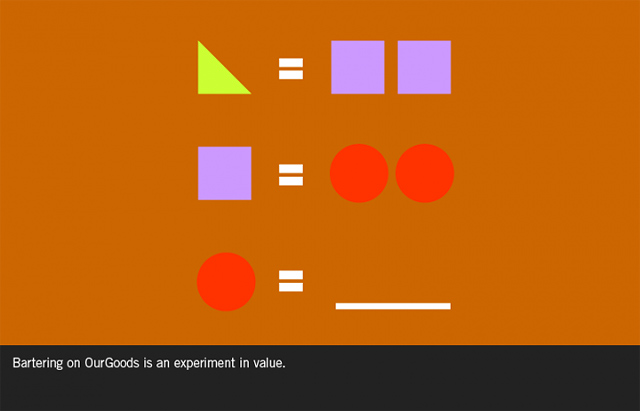
image courtesy of OurGoods.org/resources/ethics

This is part of an ongoing set of one-question emails sent to people we know, or would like to get to know, about things that interest us and inform our collective practice. They’ll be featured on the site weekly, usually on Fridays. These questions are more about unfolding ideas than about the people we’re asking, but we do ask those kinds of questions too.

We’re pleased to continue this project with a question for Caroline Woolard, one of the founders of two incredibly great initiatives, OurGoods.org and Trade School.


How can we not only define, but also enact, a new set of ethics and values that could transform the way we share, organize, and create?

Most people already have curiosity, enthusiasm, and strong desires to speak truth, hone a craft, produce beauty, and connect with others. So I will rephrase the question: How can we practice sharing, organizing, and creating in ways that transform ourselves, our communities, and the world? Here are some ways I do this:


Create online tools for collaboration and exchange!

We are only twenty years into the internet-era. We are in a beautifully experimental stage of the information revolution. Since the internet reached a critical mass in 1990, many people have been asking online platforms to foster deep connections in real time and space. At OurGoods.org, we support the production of new work through barter, because resource sharing is the paradigm of the 21st century. OurGoods is specifically dedicated to the barter of creative skills, spaces, and objects, because we want to build tools for the communities we are part of.


Learn from elders in sharing communities

We are in a contemporary fumbling for sharing rituals at intimate-distance. I’ve been looking to 30-year-old intentional communities and collectively-run spaces and institutions for advice. I’ve been visiting the intentional community Ganas, in NYC, to learn about the relationships they’ve built to share money, cars, houses, and work for over 30 years. At Ganas, for three decades, a voluntary daily meeting is set aside for members to talk through their personal struggles with cooperation. Members of Ganas recognize that no change will happen unless we struggle to “become the change we want to see in the world.” We are conditioned to compete, talk over, and gossip. We need more spaces to practice cooperating, listening, and working through conflict. Jen Abrams, a co-founder of OurGoods, has worked in the oldest collectively-run women and trans theater space for 13 years. She reminds me that, “you have to take time to check in with one another…emotions are not efficient… either you address your feelings together before the meeting, or you end up working through them while trying to have a meeting.”


Vocalize your Values

At Trade School, we asked a facilitator to help us come up with our principles. We talked about why we were each involved in Trade School New York (there are now Trade Schools in over 6 countries) and brainstormed about the things that are at the core of our work (the things that probably won’t ever be changed). After 2 hours, we made this rough set of working principles:


WHAT?

1. Trade School is a learning experiment where teachers barter with students.

2. Trade School is not free– we believe in the power of non-monetary value.

3. We place equal value on big ideas, practical skills, and experiential knowledge.

WHY?

1. Everyone has something to offer.

2. We are actively working to create safe spaces for people and ideas.

3. We want more spaces made by and for the people who use them.

HOW?

1. Trade School runs on mutual respect.

2. We avoid hoarding leadership by sharing responsibilities and information.

3. We are motivated by integrity, not coercion.

4. Our organization is always learning and evolving.


Practice forever

We recognize that bartering is a way to experiment with value. Because value is subjective, some people may not value the work that you make as much as you do. After bartering for years on OurGoods.org, we’ve come up with these basic guidelines:


1. Be clear: Define the exchange. Articulate what constitutes a job well-done.

2. Do your homework: Read your partner’s profile and feedback. Meet before you agree.

3. Be accountable: Do what you said you were going to do, when you said you’d do it.

4. Communicate: Stay in touch. Talk about what’s going right (or wrong) as it happens.

5. Leave feedback: This is what makes our community work.


Caroline Woolard is a Brooklyn based, post-media artist exploring civic engagement and communitarianism. Her work is collaborative and often takes the form of sculptures, websites, and workshops. Woolard is a co-founder of OurGoods.org and Trade School, two barter economies for cultural producers, and a coordinating member of SolidarityNYC, an organization that promotes grassroots economic justice.

Two Tales of a City opens in Hamilton!

As February wrapped up, we prepared our bunting and banner components to be shipped up to Hamilton for the install. Sara and I went to Canadian Tire to buy Scotch Guard to weather-seal and water-proof the work.
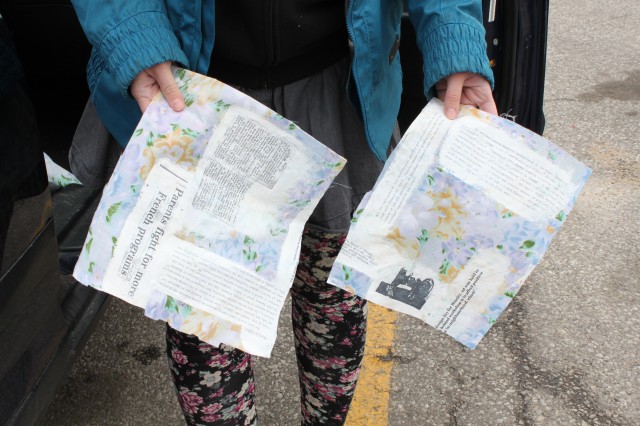
We bought two different kinds, both sealed the fabric adequately after setting to dry for a few hours.
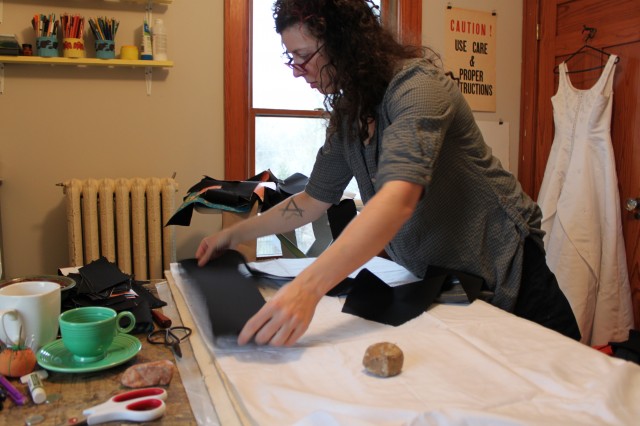
Next, we stopped off at Jodi‘s studio in The House to help her finish cutting and sewing the rest of the Helvetica text letters.
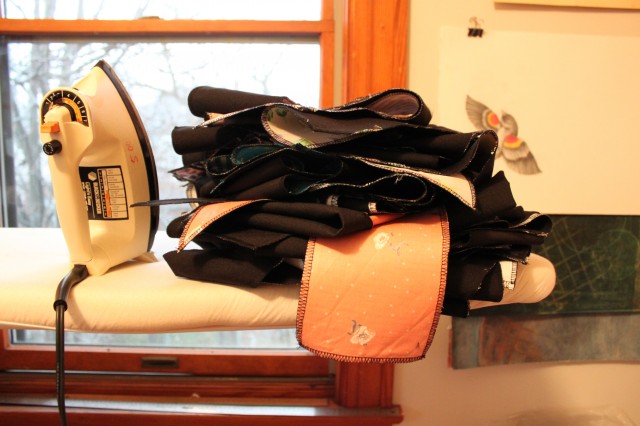
The letters are black with a backing and a layer of Heat N Bond Ultra adhesive in between, for mass and stiffness.
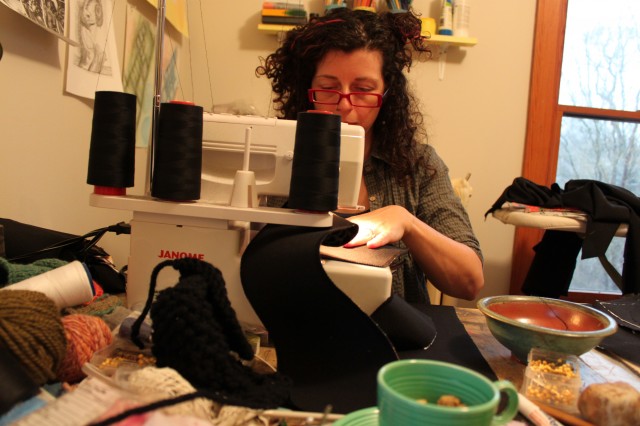
Jodi had mentioned that she was fortunate her surger hadn’t had any problems throughout the project. Shortly thereafter, a needle bent and we had to switch to her other machine to complete the remaining letters.
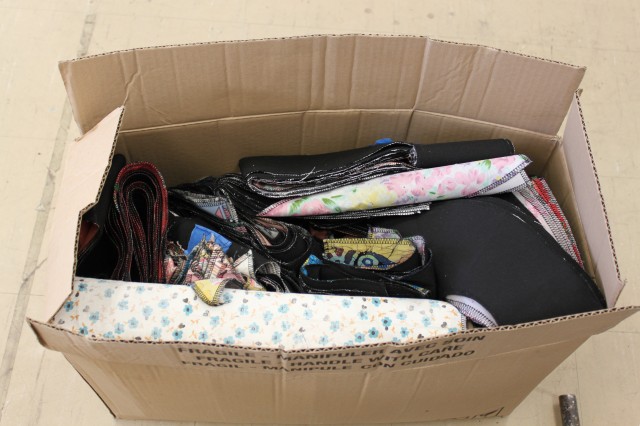
Once all materials were in one place, we counted, folded, and packaged everything up to fit neatly in this tiny little box. (Amazing!) This was sent off earlier on in the week to Hamilton Artist’s Inc so that Julie could start the install before we arrived on the 9th.
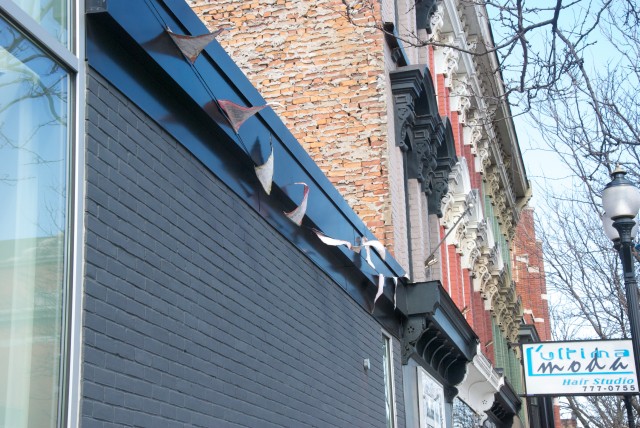
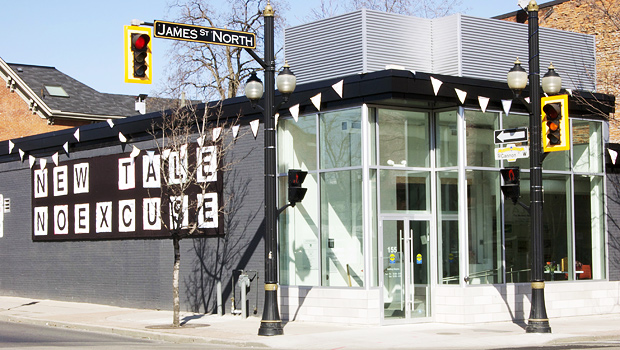
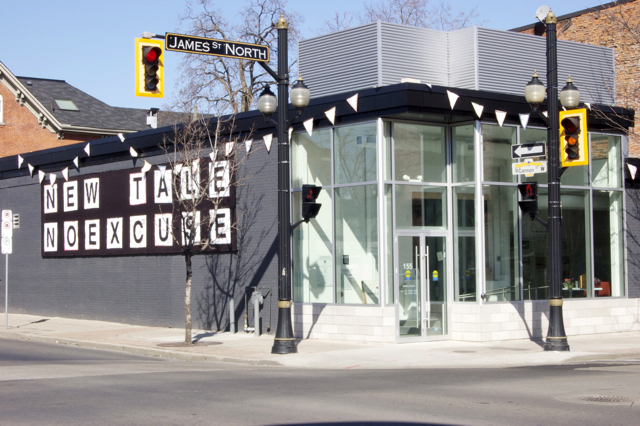
Once in Hamilton on March 9th, we headed to Hamilton Artist’s Inc to check out how the install was going. The bunting looked awesome on the front of the building!
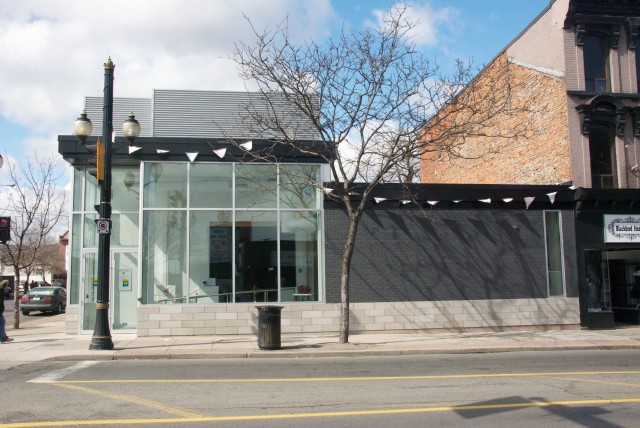
Another shot from James Street.
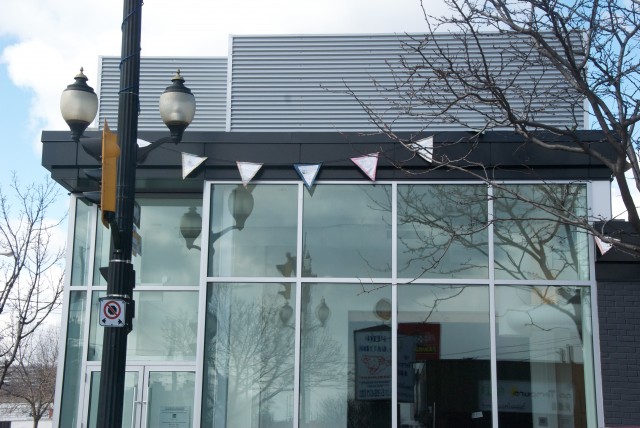
Pieces of this bunting will be distributed to various individuals and organizations in the final stages of the project.
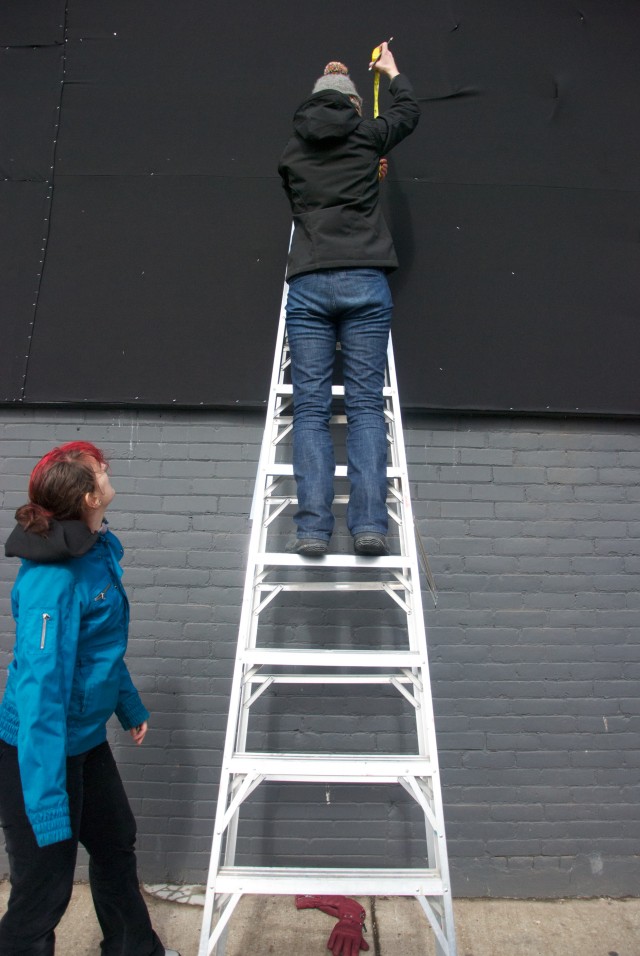
The banner along Cannon Street, an unforseen frosty wind tunnel, wasn’t fully installed yet. We helped Julie measure and install for a few hours.
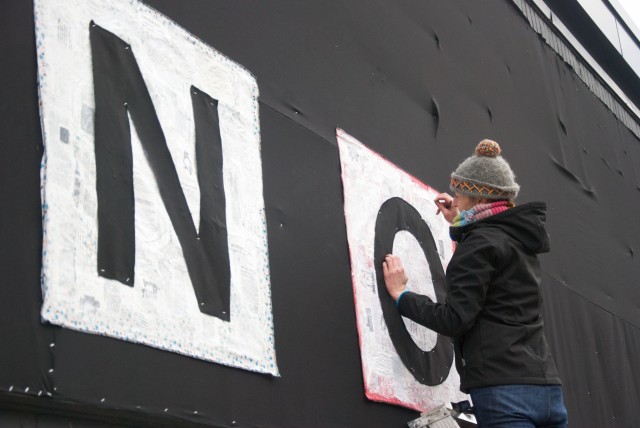
The install was a lot more slow-moving than expected, mainly due to the wind.  We were able to get a few letters up before heading over to the Farmer’s Market to set up for the workshop.
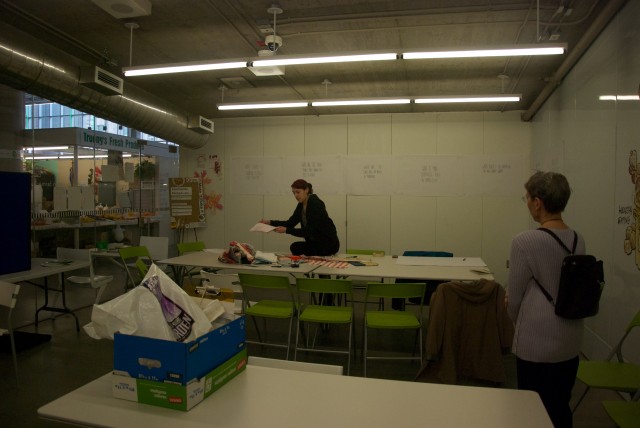
This space, called the Community Kitchen, is for rent by the hour in the Hamilton Farmer’s Market.
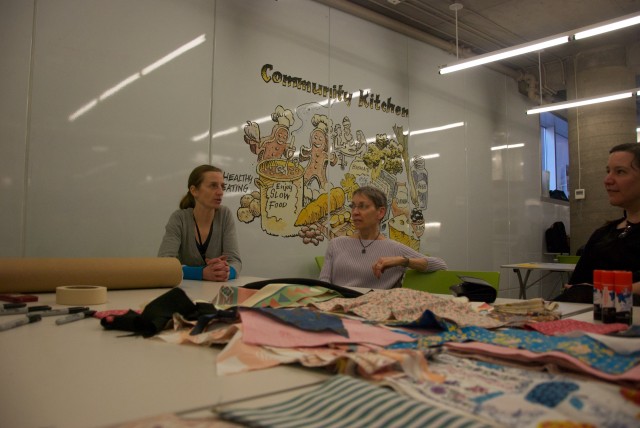
A white board wall? Pretty awesome. Wish we had one of these on hand at all times!
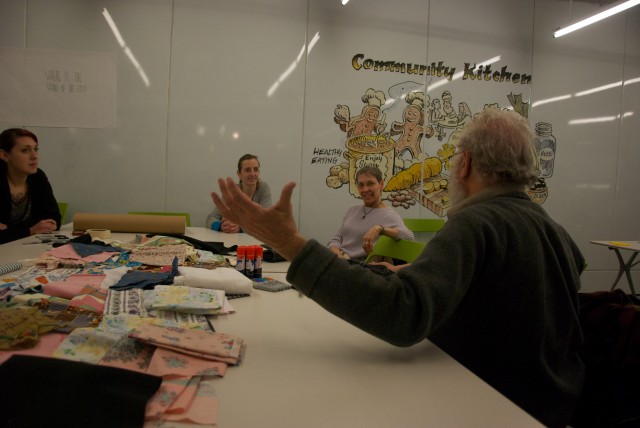
The workshop began with a discussion about headline stories that the rest of the country hears about Hamilton, then we started talking about the local stories, both published and passed on orally, specific to the city and city residents.
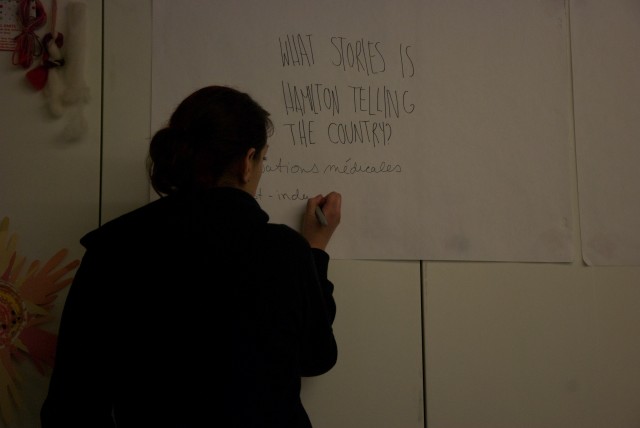
We ran the workshop in both French and English, as we had both French and English speaking people in attendance. Julie was on-hand to help translate. I wrote attendee’s comments and answers  on board-meeting-sized sheets of paper lined up on the wall.
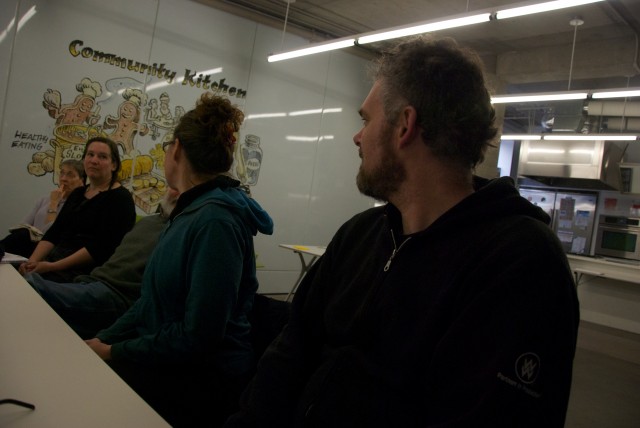
We then moved the conversation toward places in Hamilton, favourite places, places you avoid, places you go to speak/hear french.
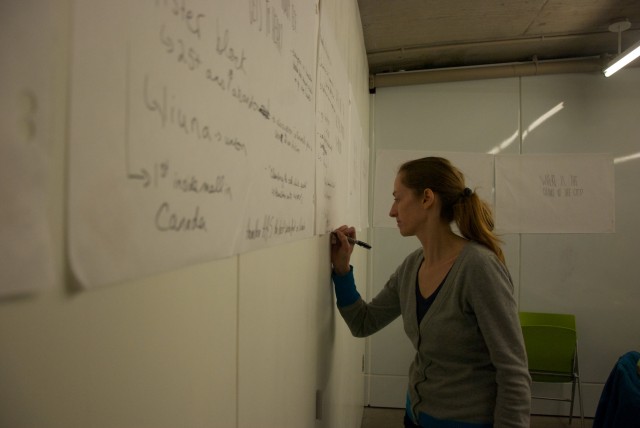
Julie helped out with writing when a lot of good things were being said and I couldn’t keep up!
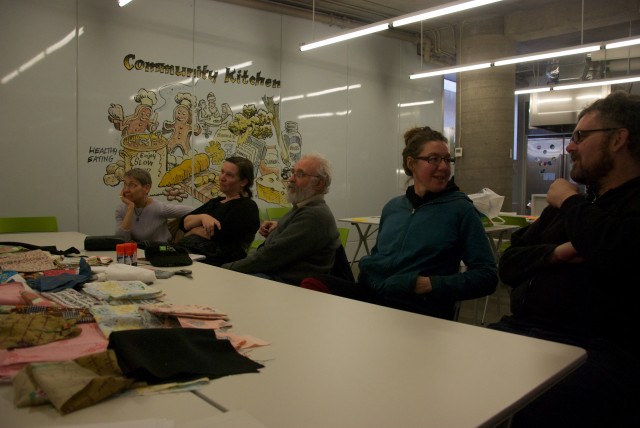
Everyone had a lot of good insights, as most were originally from Hamilton, or just generally curious and good observers of their city surroundings.
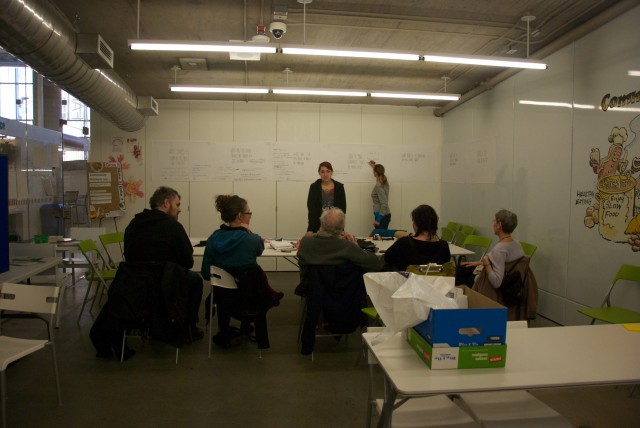
Stories of development for buildings previously sitting vacant in the downtown core, tales of infrastructures designed to keep people moving, failed and forgotten industries, rumours of neighbourhoods with bad reputations and stories of missed and seized opportunities were all shared.
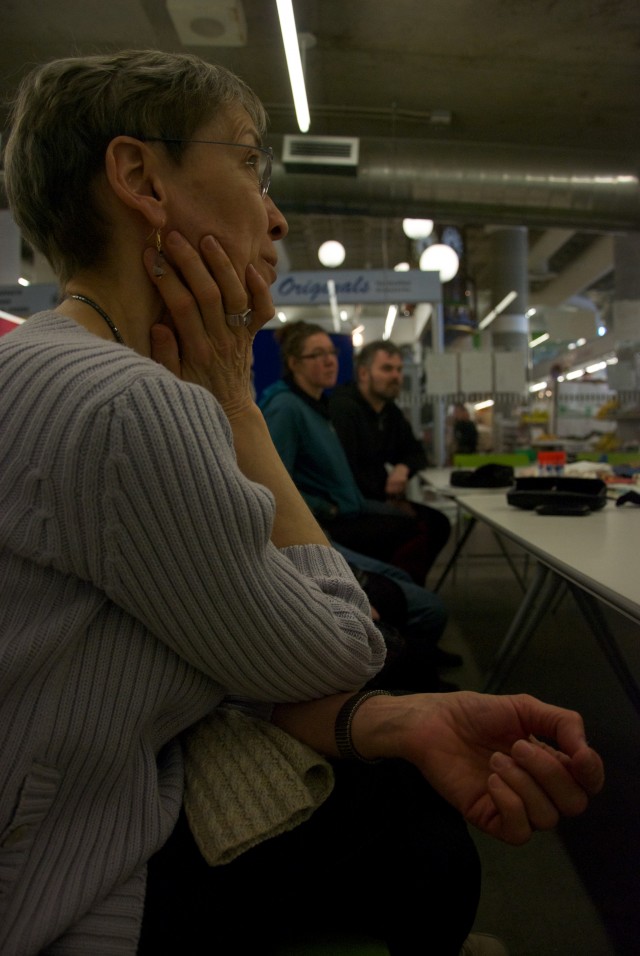
This woman, a francophone, had a lot of insights into local francophone culture. She also told some amazing personal stories about her experiences as a francophone in Hamilton.
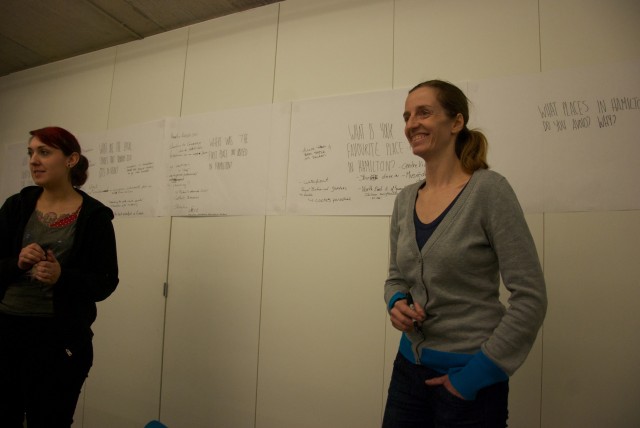
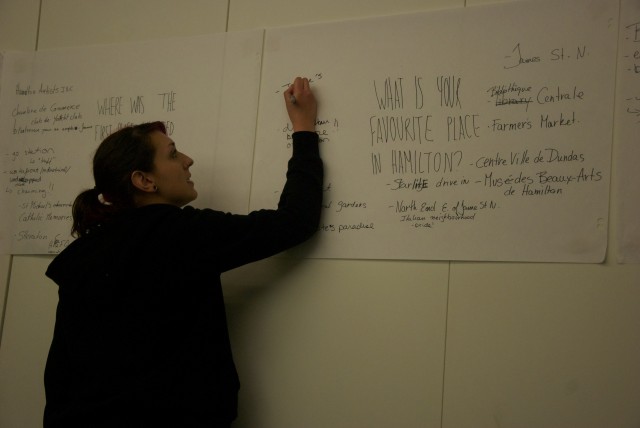
 

Some favourite places in Hamilton: James St N, Bibliothèque central, Musée sea beaux-arts de Hamilton, The Starlite, among others.
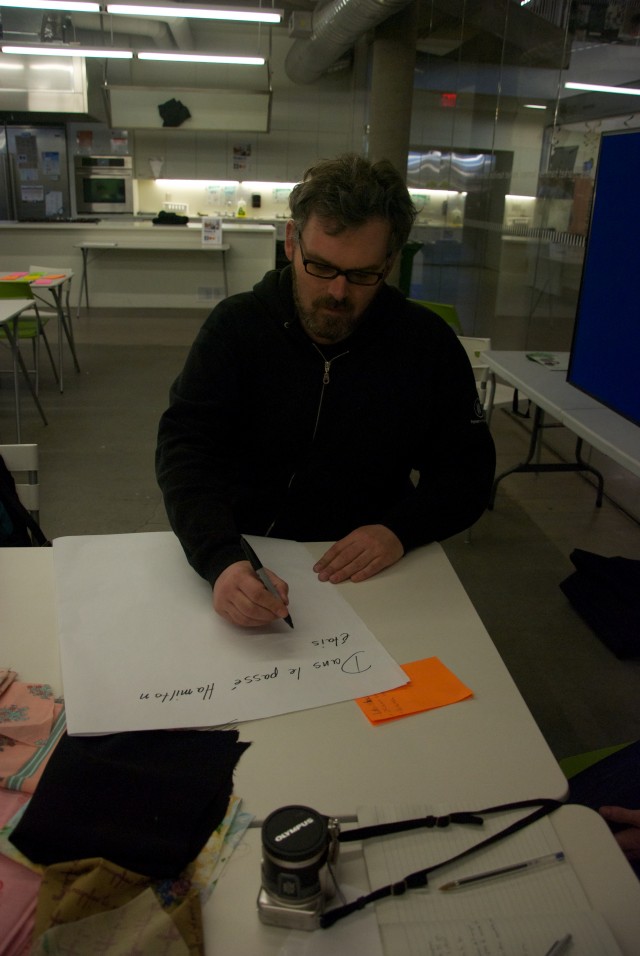
We then passed along a big sheet of paper and re-wrote an exquisite corpse-style history of Hamilton, in Franglais. Starting with the past, the story moved through to the present and then the future with each participant’s additions.
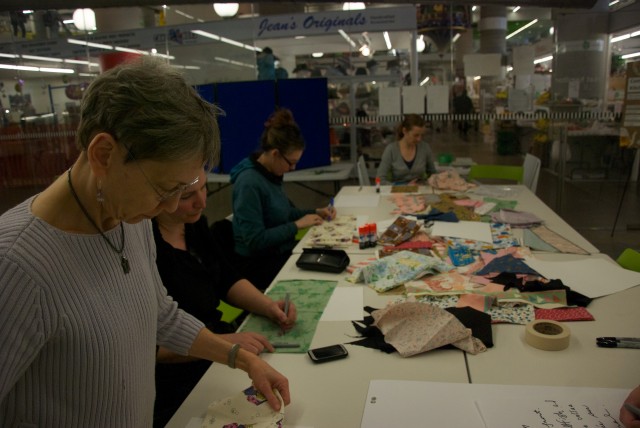
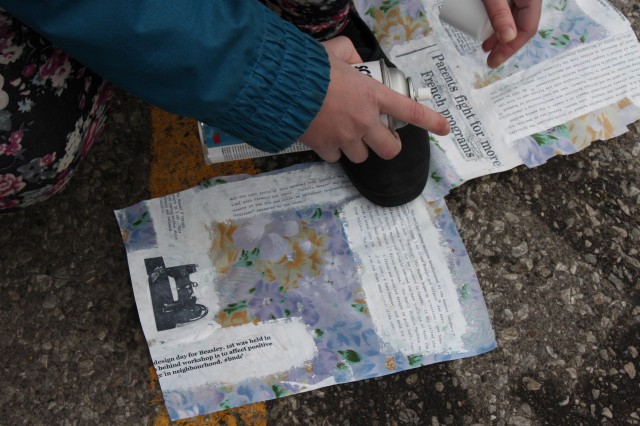
As the story was being passed around, we began work on our collaged maps. Using scraps of fabric, card stock, glue and sharpies, participants made artistic maps of a site, place or space in Hamilton discussed previously.
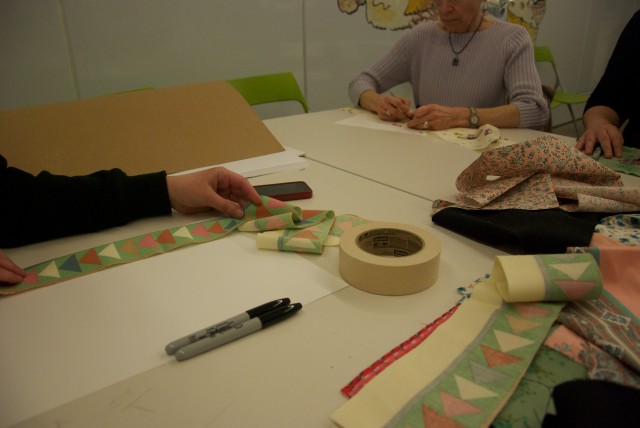
I used these strips of arrows to show one-way roads in the downtown core, namely Main St, and King St.
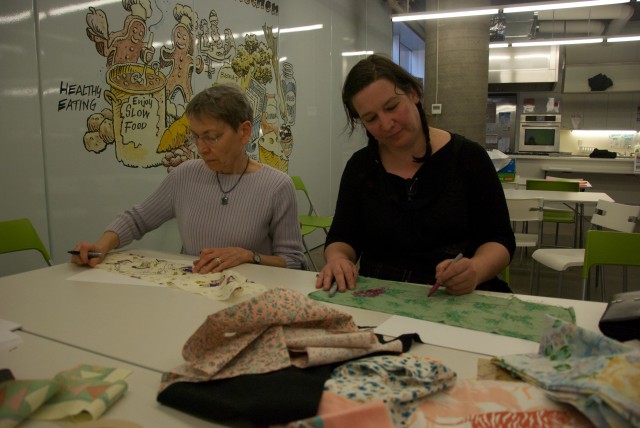
There were lots of fun materials and patterns to pick from.
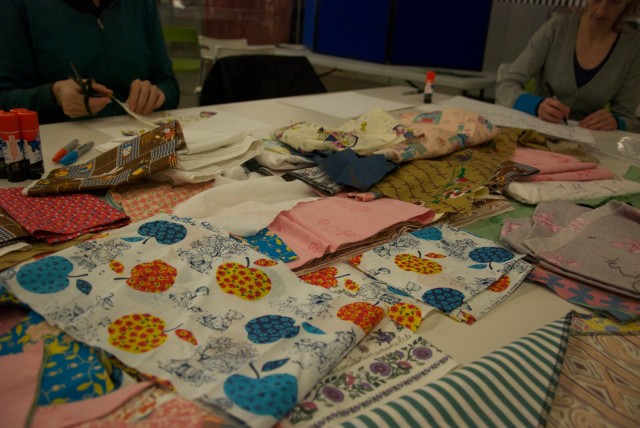
Here a participant is adding to the Hamilton narrative while another is making their map.
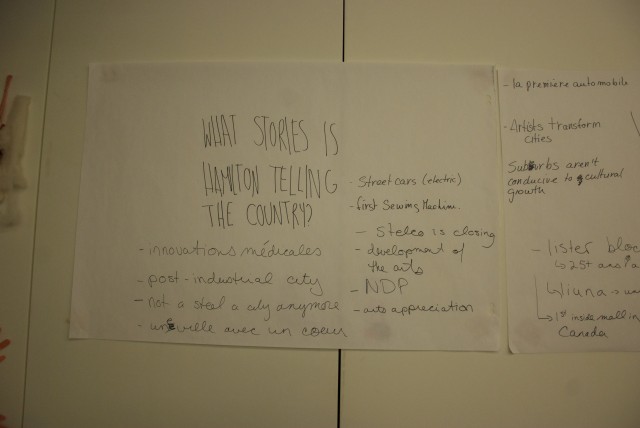
Finished brainstorm sheets; What stories is Hamilton telling the country?
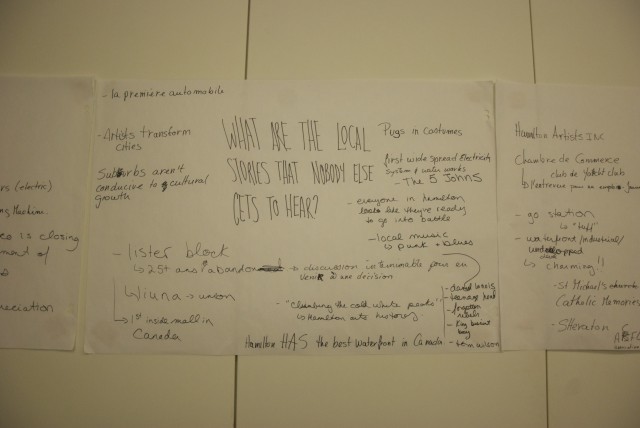
What are the local stories that nobody else gets to hear?
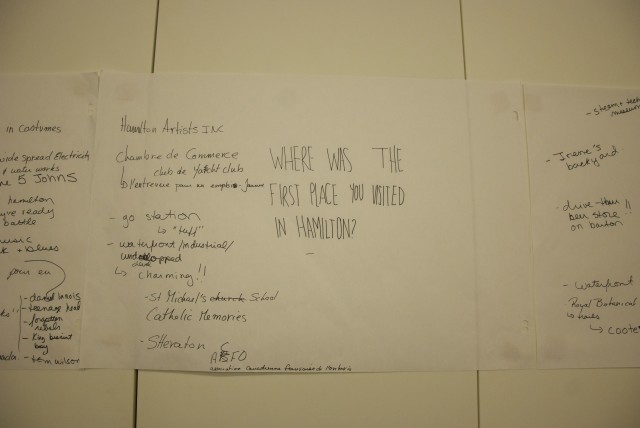
Where was the first place you visited in Hamilton?
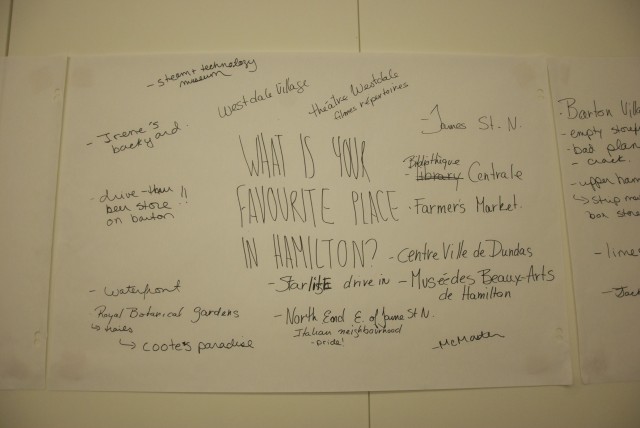
What is your favourite place in Hamilton?
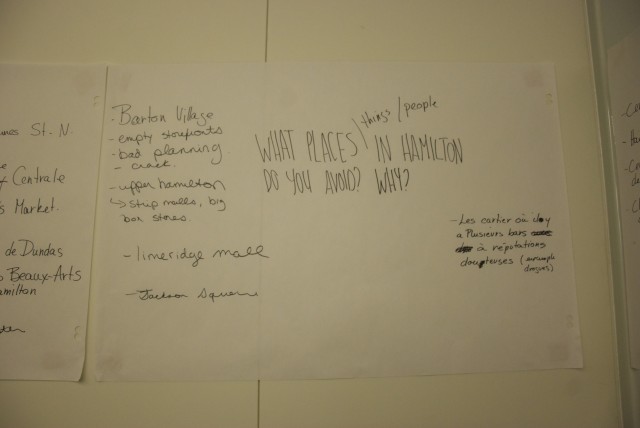
What places/things/people do you avoid in Hamilton and why?
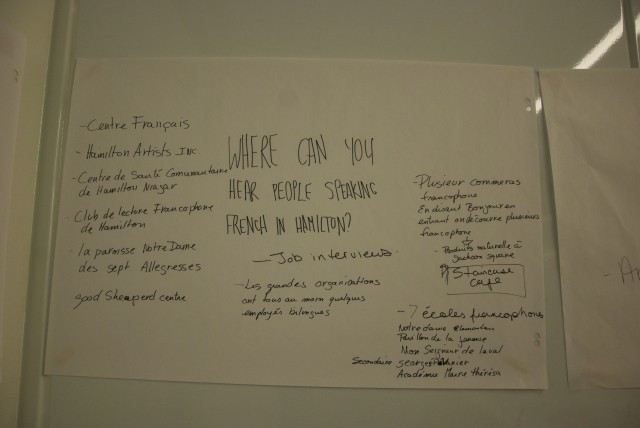
Where can you hear people speaking French in Hamilton?
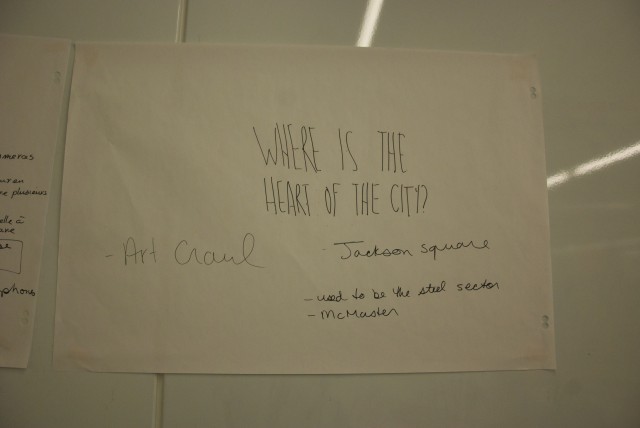
And finally, where is the heart of the city? The general consensus is that Jackson Square, the multi-use complex that hosts the Farmer’s Market, the public library and  a mall in the downtown core, is the heart of the city. Also, the monthly Art Crawls that happen the first Friday of every month were also considered to be a driving force in the city. We decided this question needed to be asked to more people, so we took it back to Hamilton Artist’s Inc to ask Art Crawl attendees.
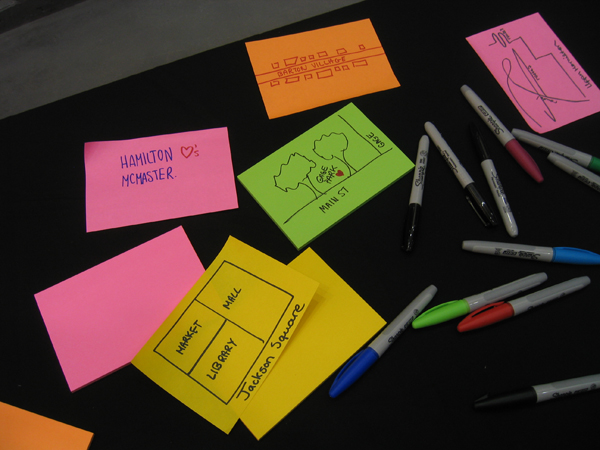
Back at HAI, we set up a table in the lobby for Art Crawl perusers to interact and participate.
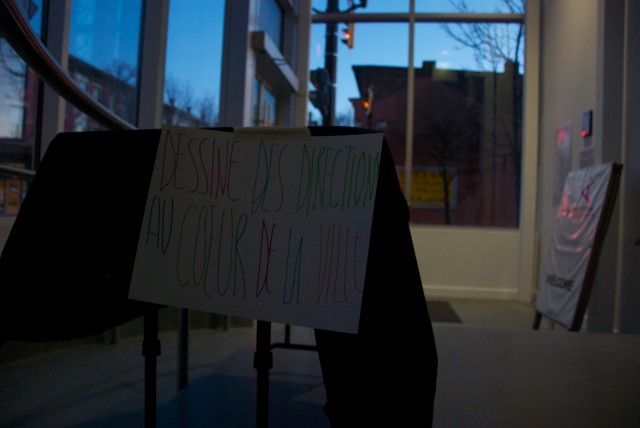
Signs in both English and French were displayed, asking Art Crawl-goers to draw us a map of the heart of the city.
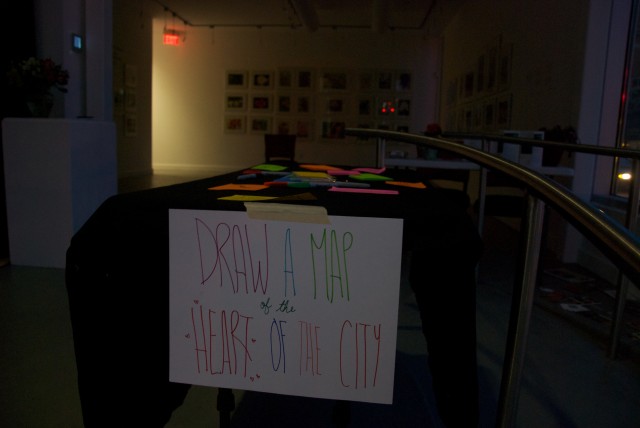
With super-sized post-its and some bright coloured sharpies, we thought this activity would be fun and quick for people of all ages and abilities attending the Art Crawl.
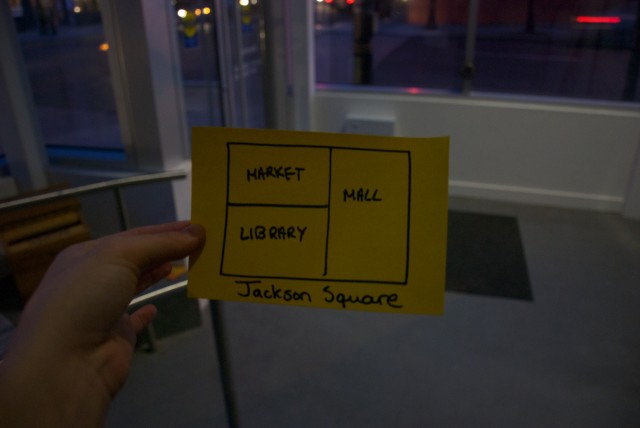
I drew an example, a rough interpretation of Jackson Square.
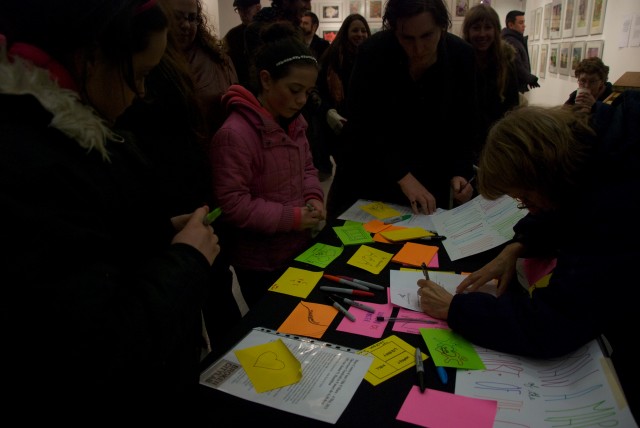
Everyone was having so much fun drawing maps during the Art Crawl!
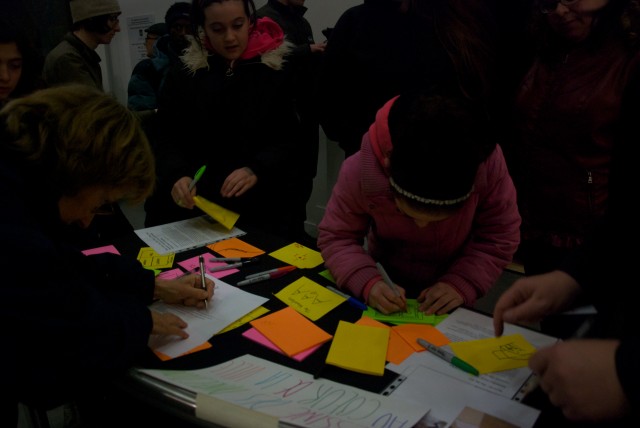
We had to leave before the night was over, but we are looking forward to having a look at these maps, and possibly including them in the forthcoming Two Tales of a City publication.
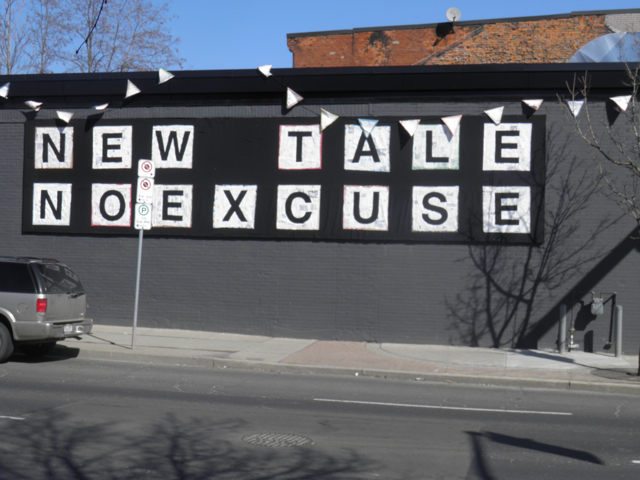
The first iteration of text of the banner on Cannon Street; NEW TALE NO EXCUSE
Watch out for more messages over the next two months! Want to participate? Fill out our Hamilton form, aussi en Français.


In Store: OVER THE BRIDGE

Another week, another instalment of In Store by Daragh Sankey. Having these weekly videos is so great and it’s amazing to look back on all of this. So, here’s the story this week:

This week, we follow Thea Jones over the Ambassador Bridge to Detroit.

Thea had recently done a research paper about Detroit. I’m pretty sure she was drawn to the Windsor residency for the opportunity it presented to visit what has become the poster child of broken post-industrial cities. I also was fascinated by Detroit; I’m sure many of us are. Toronto, where I’m from, is sort of the opposite: a thriving, very expensive downtown, where successful information & service industries have replaced industry.

This was in contrast to Windsor residents who of course, being right across the river, are pretty used to Detroit. Its ruins are much less exotic to them. So don’t roll your eyes at the ruin porn, Windsor pals! The film doesn’t really stay there; the field trip to Heidelberg is a trip to a whole other side of Detroit-the-symbol.

Keep your eyes here: http://angryrobot.ca/instore/

In Store: Laura of Bell Payphone Labs

The series continues… with an introduction from Daragh’s site:

There is a whole narrative to Bell Payphone Labs. Laura got into the lab coat for every installation she did, playing the role of the phone scientist. She had a little lab area in the storefronts the whole time as well, with educational posters about her department’s enterprises. I realized I had some assumptions about artists heading into this project: artists worked alone, used their own identities, and were removed from day-to-day life. Like lawyers, or dentists. But over the course of things I realized there were many artist collectives, artists who assumed different identities, and many who engaged with the world in far more interesting ways than I was expecting.

Evan Roth’s Art & Hacking Class

http://vimeo.com/37927700

Danielle, Michelle and I were over in Detroit at the recent INITIATE panel discussion and Evan Roth made a presentation on the early stages of some of this work. It’s awesome to see where it went — hopefully we’ll have a chance to head over and check out the show. Here’s the details from Roths’ site

Welcome To Detroit
Works by Evan Roth
Curated by Gregory Tom

Eastern Michigan University’s University Gallery
900 Oakwood Street, 2nd Floor
Ypsilanti, MI 48197

Reception @ EMU’s University Gallery October 14, 4:30pm – 7:00pm

March 8, 2012: It is no secret that Detroit’s creative community has been attracting media attention of late. What started as photos of “Ruin Porn” and “$100 Dollar Houses” led to a flood of additional articles on creative activity in Detroit.

Evan Roth’s exhibition, Welcome to Detroit, will feature nearly all-new work, much of it made during his residency. The work follows his core conceptual framework of appropriating popular culture and combining it with a hacker’s philosophy to highlight how small shifts in visualization can allow us to see our environment with new eyes, whether online, at home, in the city or at the airport. His work acts as both a mirror and vault to contemporary society, creating work that reflects and withstands a world of rapid advancements in computing power, changing screen resolution and repainted city walls.

For Welcome to Detroit, Evan mines everything from the spray paint can, to hip-hop music, to airplane shopping magazines and flight safety cards, resulting in a show that moves freely across media, but always with a sense of pop cultural pranksterism. From individual art objects to video pieces to documentation, the work is designed to simultaneously serve as a record of activity and creative output, while also underscoring important issues concerning copyright, public space, and our offline and online identities.

Additional information on Evan Roth can be found at http://evan-roth.com/about/.

“Reading is Necessary for Understanding the World:” Advocating for Open Access in Art & Social Practice Research

Today, I was asked by a PhD candidate in Library and Information Science at the University of Western Ontario, if and how my MLIS education has shifted or changed my view of technology.  Before entering this program, my academic research was predominately rooted in ways in which technology, digital media, and social networking can be used to preserve, organize, and most importantly, share information.  Technology certainly does have the capabilities of creating these opportunities, but entering this program has also  illuminated the strong restrictions that are placed upon digital information.

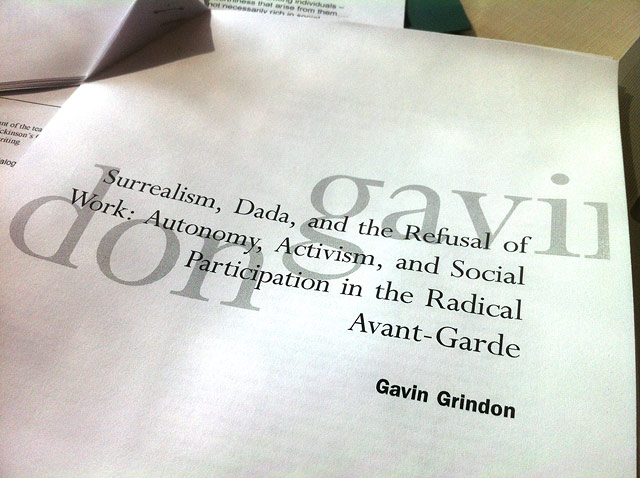
Thinking back on Justin’s thoughts Toward a New School of Art, he states, “reading is necessary for understanding the world,” and thinks about how art education must not be restricted to a traditional academic classroom setting in order to stay relevant.  Blurring these two ideas together, I also feel that art research should be viewed in a similar light.  Art education and related information literacy should be about about participation, collaboration, and especially access.

Academic research goes through a long process to be published.  The Atlantic’s recent post on the topic clearly explains the process all the way from a paper’s conception, to its publication, to its exclusive academic library access.  Open Access is one way in which scholarly research has been able to avoid this, and in turn, allow publications to receive broader readership.  Open Access refers to the practice of providing unrestricted access to peer-reviewed scholarly journal articles online.  Many of these can be found through the Directory of Open Access Journals.

As seen by programs in place both at Emily Carr University (where Karlyn is studying!) and Portland State University‘s, the field of art and social practice is emerging.  As it grows and its scholarship develops, I hope its practitioners and researchers will continue to keep art and  social practice collaborative and go down the Open Access route to keep creative engagement accessible.