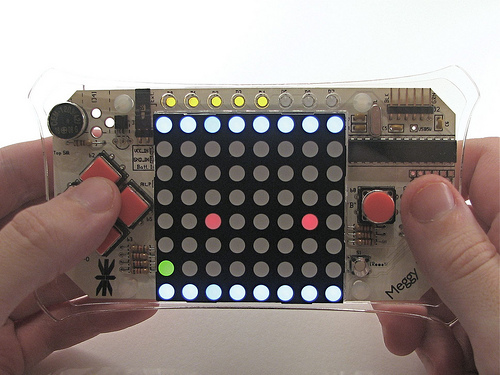
Made by the folks at Evil Mad Scientist Laboratories, this open source game kit, Meggy Jr RGB, allows you to program your own games using the 8×8 LED matrix and controlling the gameplay through those 6 big red buttons. You know what this means, Broken City Lab video game.
There are a lot more images of this work that better show the enormity of it and help to frame the reading of the description of it, but in some ways this video is a more interesting introduction (as time-lapse always is).
A City Renewal Project is a project by fauxreel and Specter that recreates a neighborhood full of abandoned storefronts inside a 4000 square foot warehouse at 39 Lisgar Avenue in Toronto (which is going to be demolished to put up a new condo). The project focuses on the state of decay within the city, renewing these dilapidated buildings as artistic monuments and documenting their history amidst the gentrified frenzy of urban change. The Mr. Loogie building you see in the above video is the entrance off the street into the warehouse.
The article in the Torontoist spells out some of the specifics of the installation as well as some of the politics surrounding it (the work is sponsored by Gallery 381, which receives financial support from Red Bull). That argument is detailed in an article in NOW.
I enjoy the project as it exists as a partial, imaginary archive of the city, and I enjoy it even more because it’s housed in a warehouse that’s going to be torn down in favour of gentrified architecture and space, but the more I think about it, the less I enjoy the project for those same reasons.
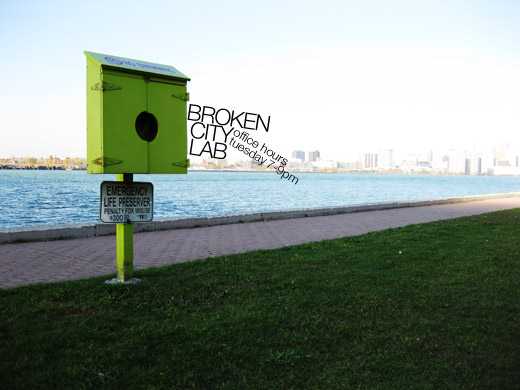
We’re going to be holding office hours Tuesday, November 11th, from 7-9pm at LeBel, room 125. Feel free to drop by to contribute, engage, ask questions, and fix this city. We’ll be discussing upcoming projects, ongoing research, and our next demo/event.
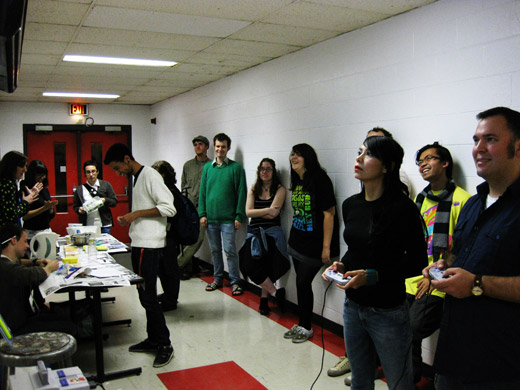
Our Tetris Tournament / Wheatpaste Demo / Sticker-Making Party went amazingly well—we successfully hijacked that big TV in the Lebel hallway, the tournament was filled with high-stakes Tetris 2 action (you can see Susan and Craig battling it out above), we demoed our wheatpaste recipe (hot water + flour until its a smoothie-like consistency) and lots of people made stickers for our commemorative plaque. Thanks to everyone who came out and made this thing happen!
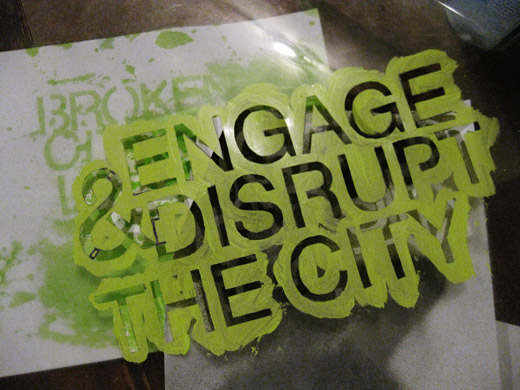
In preparation of the upcoming event, and in response to our sudden acquisition of 4 t-shirts, we spent Tuesday evening making stencils, shirts, testing Tetris 2, wheatpasting, and figuring out the logistics of a video game tournament.
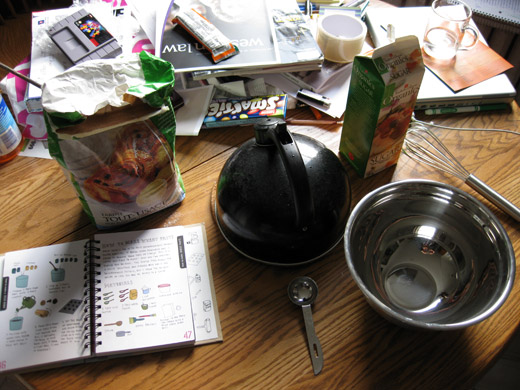
Danielle and I spent the better part of the afternoon a couple days ago going through wheatpaste recipes, ultimately going with the simplest. We had wanted to avoid having to use a hot plate to make it, and after 4 different recipes requiring varying amounts of heat, we were successful.
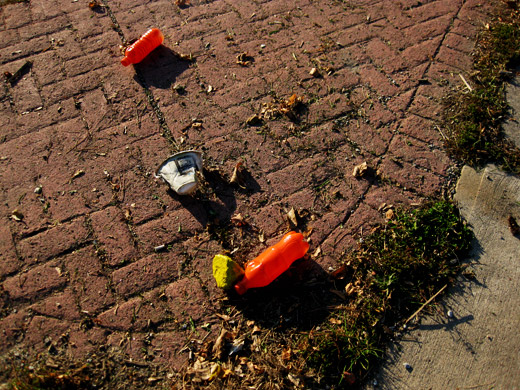
I saw this on my way home from Lebel today. Earlier in the day, on my way to school, I had seen some bright yellow chunks of asphalt on the south side of Mill Street, where that little cul-de-sac is, right beside Huron Church. I didn’t think much of it, though remained curious about it. There are a few more pieces placed around the area, some purple-coloured sticks, other orange coloured garbage, and some more yellow asphalt. At first I didn’t like the idea of placing more garbage around there, but then caught myself—I hadn’t really noticed there was garbage there before at all.
The more I thought about it and saw the pieces subtly (if bright orange plastic containers can be subtle) spread around, peaking out from the leaves on the ground, the more I liked it. Is this work from Advanced Sculpture?… I know they’ve been working with the idea of interventions.
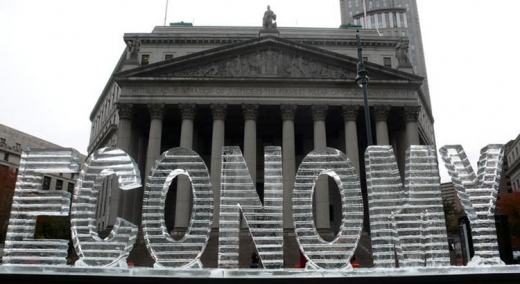
In honour of the 79th anniversary of Black Tuesday (the day the U.S. stock market crashed), artists Nora Ligorano and Marshall Reese installed this ice sculpture of the word ECONOMY in front of the New York Supreme Court building on October 29th. Over a period of several hours, the sculpture melted completely. The artists interviewed viewers on-site and also took time-lapsed photographs as well as video of the project.
This piece is almost too perfect. We have been throwing around many ideas for upcoming winter projects with ice, and I somewhat wish we had thought of this first! It fits all too well with the current situation Windsor finds itself in, and what we, as artists, are trying to accomplish in the city. We can definitely learn a lot from this project.
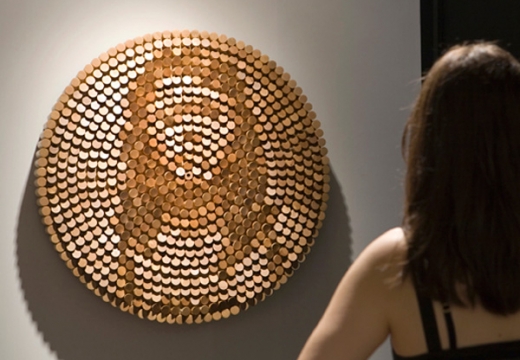
“Peg Mirror comprises 650 circular wooden pieces that are cut on an angle. Casting shadows by twisting and rotating, wooden pegs forming concentric circles surround a small central camera. The mirrored image produced in this work is activated by software authored by Rozin that processes video signals and breaks up imagery geometrically, seemingly pixel by pixel. The silently moving wood components in this piece flicker like jewels or coins in the spotlight, challenging our notions about what constitutes a “digital object”.”
This blew my mind, mostly because of its complexity. Making shadows work as pixels in real time is new to me. I’d love to be a part of a project like this.