Bureau for Open Culture: DESCENT TO REVOLUTION

Audible Dwelling by Learning Site

Descent to Revolution, and exhibition / residency created by the Bureau for Open Culture, features five international artist collectives and collaboratives that use urban spaces and social spheres as means of production and inspiration. During the course of the exhibition, participating artists visit Columbus in a series of residencies to make projects specific to the city. The work does not take place inside the space of the gallery but in concert with community and physical mediums outside of it.

Contributing to the exhibition is Claire Fontaine, Learning Site, Red76REINIGUNGSGESELLSCHAFT, and Tercerunquinto, and all will be working within some relation of the city of Columbus and its community.

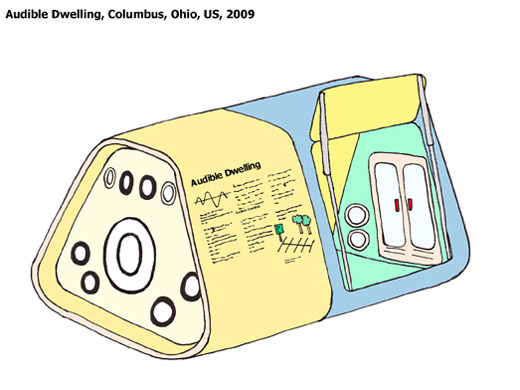
Pictured above is Audible Dwelling by Learning Site, a combination loudspeaker and dwelling that responds, in part, to the proliferation of abandoned malls, parking lots, and housing in downtown Columbus. Audible Dwelling is situated in a parking lot on CCAD’s campus. During their dates of residency visitors follow the arrows on the floor out the gallery door to visit Audible Dwelling, to experience it by listening and by leaving a story that is eventually projected into public space via loudspeaker.

Will there by time for a road trip to Columbus???

This project is really exciting to see for a number of reasons, maybe the top one being that it’s nearly exactly what I wish we could do… I wish we had the money to do something as large-scale as this, or even money just to pay for materials for projects we’d like to realize through a program like this. For now though, our Micro-Residency project is getting some great submissions, and hopefully we’ll be kicking it off in the next few weeks, and doing a bunch of amazing things for free.

[via Art&Education mailing list]
A Pay-As-You-Go City

parkingmeterfail

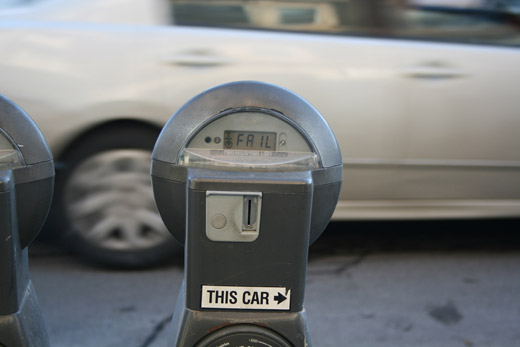
An interesting article over at BLDGBLOG imagines new options for cities facing huge deficits, essentially asking: if you didn’t pay taxes, would you be willing to pay higher fees for service, or would you rather pay even higher sales taxes and have zero fees attached to any municipal use or service?

Could an entire rethinking of city services and tax structure do anything to save a destroyed infrastructure system?  Are there economies that depend on the pay per use model (as in, what would the meter reader people do for work in a city with a large lump sum paid once per year)? And, is it inevitable that cities move towards a subscription-based model of service, where you choose a package at a specific price-point for the things you actually use?

Anyways, many questions, but certainly worth a read …

Photo by compujeramey.

Windsor: One of the Worst-Run Cities in Canada

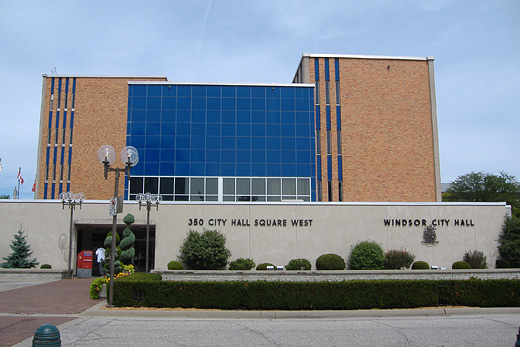
Windsor City Hall

Not that this really comes as any surprise, but a Macleans study found that Windsor is one of the worst-run cities in the country. The low grades comes from two areas in particular, efficiency and effectiveness, where Windsor ranked 23 and 28th respectively out of a total of 31 cities studied.

Now, to be fair to the Rose City, a lot of these numbers were based on concerns that come out of managing the city, that is, things like how much money does it cost to collect the trash and how much does transit cost per kilometer. Really, these are things that are indicative of poor management strategies, with Windsor ranking as one of the highest governmental costs per capita, rather than a true reflection of the ground-level problems in Windsor that one might usually encounter.

In the end, Windsor ranks 26th overall, making it just five up from the worst-run city in the country.

[via Windsor Star]

Psychogeographic Map: East Chinatown’s living and dead businesses and their smells

psychogeographic map

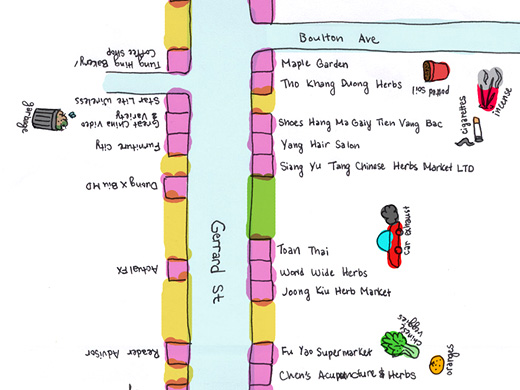
This is a small excerpt of a large map made by students in OCAD’s Cities for People summer workshop, depicting the East Chinatown neighbourhood, its businesses and their smells.

You should take a look at the larger map, which helps to demonstrate the potential in mapping outside of the continually pervasive Google Maps.

To take time to note a neighbourhood in this somewhat peculiar detail is an interestingly necessary method for interfacing with a place one might normally walk by, and in turn, of course, makes me eager to do the same somewhere around these parts.

[via Spacing]

LightLane Prototype

httpv://www.youtube.com/watch?v=WOU563OvpUY&feature=player_embedded

Josh wrote about the LightLane project a while back, and skepticism aside, it seems as though the idea is finally moving beyond just the proposal stage. The video above is essentially a proof-of-concept, but very exciting.

Looks to me like you need to ride really, really fast to get the trailing effect.

Now I’m anxious to play with LEDs again.

[via GOOD]

Urban Camping

urban camping

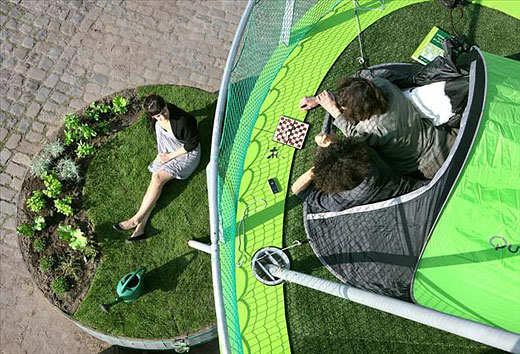
Architecture firm, Import Export, came up with a structure specifically designed for urban camping. The mobile architecture is meant to be dropped into urban spaces to provide new opportunities for for overnight city experiences.

There are a lot more photos that do the project better justice.

Long ago, we talked about urban camping, but we certainly never discussed this level of infrastructure. Maybe this project is slightly more realistic than the way I’m imagining urban camping in Windsor, but it’d be a shame if no one utilized any of the newly created acquired naturalized areas across the city for a makeshift campsite.

[via rebel:art]

Pay to Rest

Pay To Rest

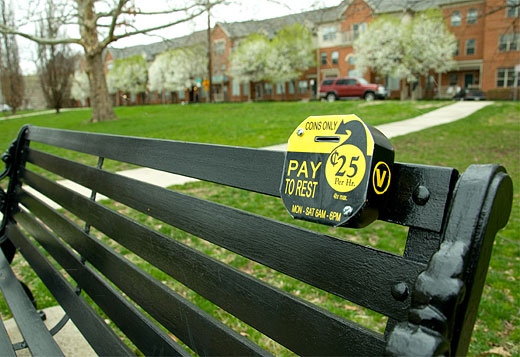
Pay to Rest by Vinchen is a simple-enough intervention, adding a suggestive coin-operated mechanism to a city bench.

It may be a one-liner, but it caught my eye a couple days ago, the photo sat on my desktop, and now this morning upon reading Amherstburg’s idea to introduce pay-per-use fees to soccer fields, baseball diamonds, etc., it made me curious about the priorities of a city when such significant money can go into certain forms of maintenance, but then shift other services to another kind of access model.

I’ll admit I’m making a bit of a leap here, but if benches were indeed pay-per-use, would it result in better kept parks? If an entire city shifted to a pay-per-use model, would things get any better? What would be the first bit of infrastructure to collapse? If the entire city operated on a subscription service model, would there be any positive change?

[via Wooster Collective]

GOOD’s Livable Streets

GOOD Magazine's Livable Streets Winner

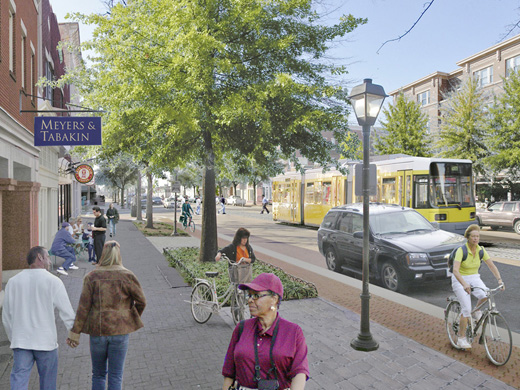
GOOD recently had a Livable Streets competition where they invited readers to do some rendering and Photoshopping of holistic redesigns. The winner, Steve Price, reimagined Portsmouth, Virginia with infill development, light rail, and dedicated bike paths.

We need to do this for Windsor. Anyone up for putting their skills to use? Maybe Scaledown should try to push something like this forward.

Urban Mediations

urban mediations

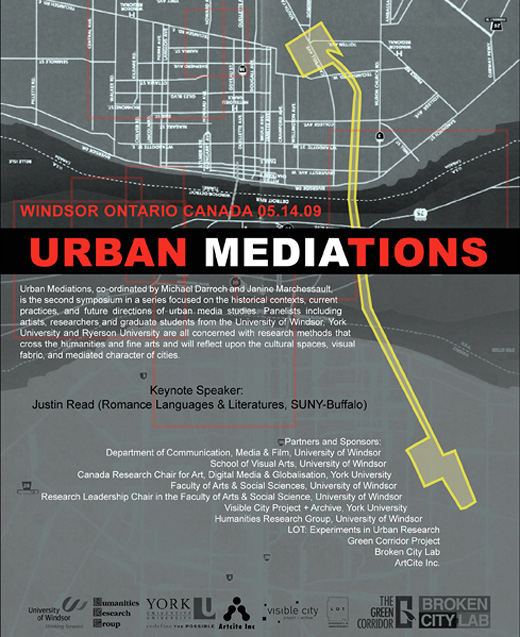
Thursday, May 14 going to be an incredible day: Urban Mediations, a one-day symposium on urban media studies is taking place in Windsor. Co-organized by the University of Windsor’s own, Dr. Michael Darroch, the symposium will involve a collection of researchers, artists, designers, and activists talking about what it means to research the urban.

I’ll be speaking on Broken City Lab, and Danielle will be talking about architecture of urban refugees, among many other fine thinkers, doers, and writers.

Windsor Ward Boundary Reviews

Ward Review

I can’t say it much better than Chris over at Scaledown, so I’ll just reblog it here:

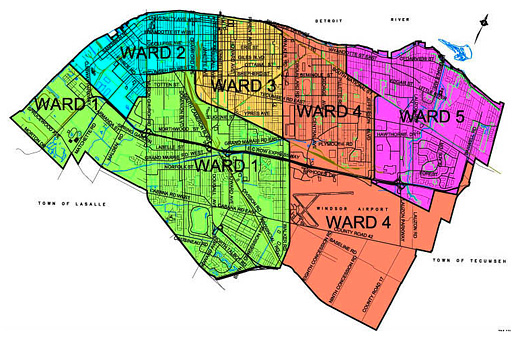
The time has come for the City of Windsor to investigate adjusting its ward boundaries to better reflect the redistribution of our population we’ve realized over the past thirty years. Yes, the last time this has been analyzed was 1978.

There has been a significant move to the ‘burbs over the course of the last three decades, and the boundaries of our ward representation has yet to catch up with this trend. Wards one and five have noticed the greatest amount of land use homogeneity with the vast majority of their residential poulation living in raised ranch housing. Wards two and three have been continuously bleeding residents to these new subdivisions, while our other urban ward, ward four, has only grown due to the recently annexed land by the airport.

There will be 3 ward boundary review meetings:

Wednesday, April 15, 7-9pm (Forest Glade Community Centre)
Thursday, April 16, 4-6pm (Windsor Water World)
Thursday, April 16, 7-9pm (South Windsor Recreation Complex)

This could dramatically impact the next election and the future of city council representation in Windsor, so if you have time, and especially if these review locations are in your neighbourhood, it’s definitely worth going.