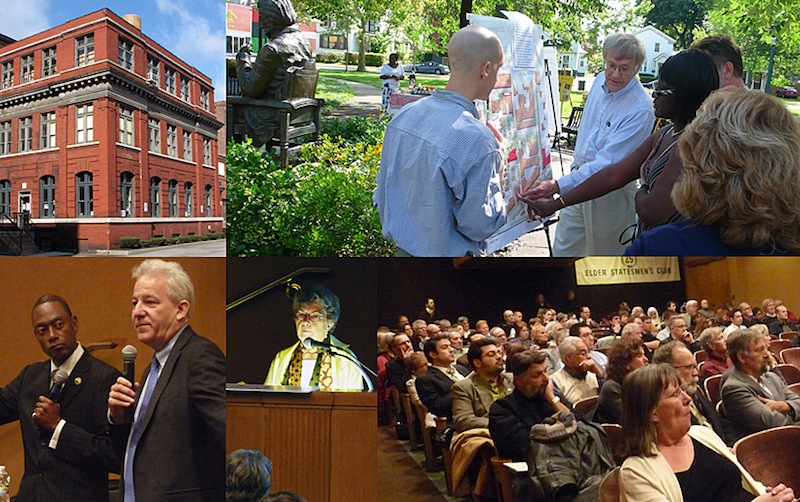
There’s a lot to say about the Creative Time Summit: Revolutions in Public Practice 2, though I’m not really sure where to start. You should start by visiting the Creative Time Summit site and watching the presentations for yourself, then you should read the excellent recap essay by Gregory Sholette and the somewhat brief, but engaged, corresponding conversation that includes some powerful ideas by Stephen Wright (whose presentation we unfortunately missed).
And, perhaps Sholette’s essay is the best starting place to articulate how I felt about the Summit, as it offers a level of complication that seemed to be missing from the Summit’s presentations and panel discussions. For all the effort to create a dynamic structure, something seemed to stall the questions and discussion that I had hoped to hear. 8-minutes presentations have the potential to create a rapid fire overview and starting place for dialogue, but it didn’t often work out that way. Some ideas and arguments needed more time to unfold, but the types of frustrations (productive or not) that came out of last year’s summit were provoked under similar circumstances, and yet Danielle and I left with no more questions than what we arrived with — and that was dissapointing.
We looked at this as an occasion to disrupt the things that we’ve come to take for granted in the type of practice in which we’re engaged, we wanted to hear tough questions that would make us fundamentally take stock in how we think about things like social practice. It could be though that we are just frustrated with the foundational location of these discussions that revolve around an art world — one that we haven’t really experience nor do we have any interest in experiencing in the sense of an art market or even really gallery exhibitions that really admit to being in a gallery.
I suppose we were hoping to have a conversation that could start with something like,
“Ok, let’s assume that there is something possible in art beyond being either inside or outside of a gallery context, and let’s assume that there are models of production that can understand capitalism but at the same time leave the critiques thereof at the door; now about this whole social practice thing…”
That is to say, certainly there is value in those discussions, but if we could just reorient these conversations about social practice and public practice and political art and art made politically to occur around different types of contexts and complications (even just briefly), what might come out of that?
Maybe, though, everyone is just at that same mental point — exhaustion and insatiability at the same time. Certainly, we didn’t help the situation; we went looking for questions that we didn’t know how to ask ourselves, and maybe everyone else in the audience did the same thing. Maybe we were all there, having been the choir that’s been preached to for so long that we’re more confused that ever in wondering about what’s at stake in all of this socially-engaged art.
This isn’t to say, of course, that there weren’t questions asked. To the contrary, compelling dialogue cropped up around a number of the session, and in particular, those on on Schools and on Geographies, but at other times old arguments were rehashed and panel members danced around questions or quietly refused to answer at all.
The highlights were — and I mean to say this with as little cynicism as possible — the opening remarks and curatorial statement by Nato Thompson and the closing essay by Sholette. The concerns articulated in both instances got very close to the issues I had hoped to hear about for two days straight. Questions about ethics, efficacy, and aesthetics start to complicate this way of working in a very useful way for me.
Perhaps it was because we went to Open Engagement and heard some of the same conversations there that we felt a level of rigour was missing or maybe I’m just overestimating what is possible in an 8-minute presentation * 4 + 30-minute discussion format, but I really, really wanted the summit to inspire and challenge me more than it did.
So, all of that aside, I can safely say that we walked away with at least two things: We can’t wait for an opportunity to see Nato Thompson speak again, and we anxiously anticipate Gregory Sholette’s new book, Dark Matter. And, we’ll be excited to see what comes up Creative Time Summit 3.