David Rokeby’s long wave

David Rokeby's Long Wave

David Rokeby is a Canadian artist who worked for years in new media, creating interactive installations, and exhibiting them around the world (including here in Windsor most recently at the 2008 Media City -curated AGW exhibition). I had the opportunity to work with him on that 2008 show, Plotting Against Time, and he is one of the nicest and most brilliant people I’ve ever met.

More recently, his work has turned to large-scale installations.  2007′s Cloud played with perception through small sculptural elements rotating under a computer’s control.

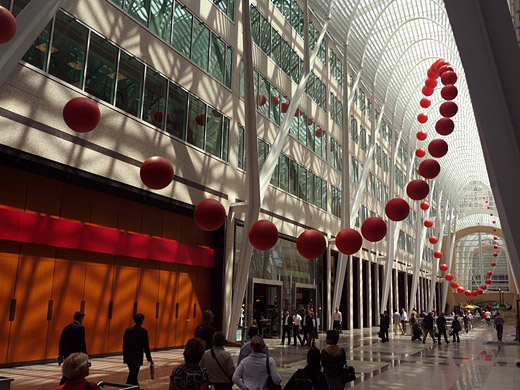
This year’s long wave is a site specific installation that was commissioned by Luminato, Toronto Festival of Arts + Creativity and was on view at the Allen Lambert Galleria, Brookfield Place, Toronto, June 5 – 20, 2009. It is a 380 foot long, 60 foot high sculpture tracing a helix through the entire length of the galleria.

“long wave” is a materialization of a radio wave, a normally invisible, but constantly present feature of environment. It represents the length of a radio wave in the short-wave radio band, in between the sizes of AM and FM radio waves. In our contemporary wireless environment, populated by tiny centimeter long wifi transmissions, these radio waves are really the dinosaurs of our communications era.

I’m getting more and more interested in larger-scale installations like this that at least in part respond to the architecture in which they are situated. With so many vacant building across this city, why worry about a sculpture garden when we could have an “installations in abandoned factories” tour?

Tagged:

↑ up


AMPHIBIOUS ARCHITECTURE

amphibious2

A project by xClinic Environmental Health Clinic at NYU and the Living Architecture Lab at Columbia Graduate School of Architecture, Planning and Preservation, AMPHIBIOUS ARCHITECTURE attempts to generate a new dialogue between the environment and us.

The description, quoted from the site, since it’s more clear than my attempt at synthesizing the information would be:

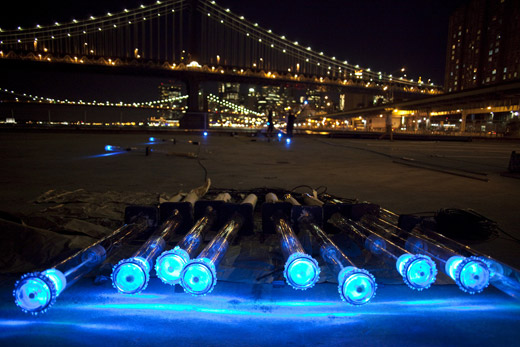
“Installed at two sites along the East and the Bronx Rivers in New York, the project is a network of floating interactive buoys housing a range of sensors below water and an array of LEDs above water. The sensors monitor water quality, the presence of fish, and human interest in the river’s ecosystem, while the lights respond to the sensors, creating feedback loops between humans, fish in their shared environment.

Additionally an SMS interface allows homo-citizens to text-message the fish and receive real-time information about the river, contributing towards the collective display of human interest in the aquatic environment. The aim of which is to simultaneously spark a larger public interest and dialogue about our local waterways.”

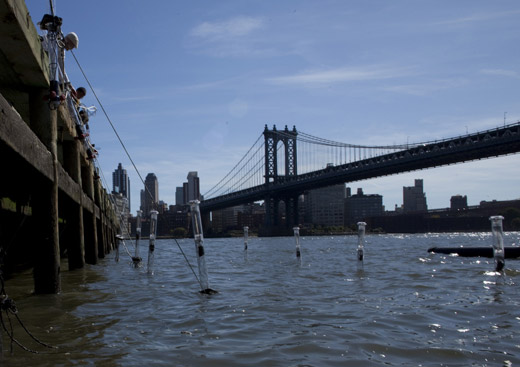
amphibious1

These are the sensors lit up before being installed in the river. To see some video of the sensors actually installed and floating, you’ll have to check out the site’s landing page.

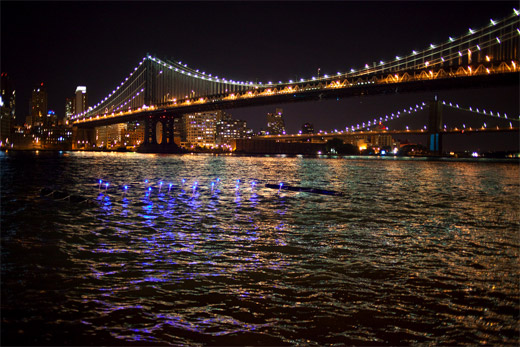
eastriver

This is an image of some of the sensors lit up, being activated by passing fish, water conditions, and text messages. It’s an amazing cool project, especially given our proximity and recent interest in imagining some kind of Detroit River based project.

Tagged:

↑ up


Eclipse – Park Pollution Visualization

Eclipse

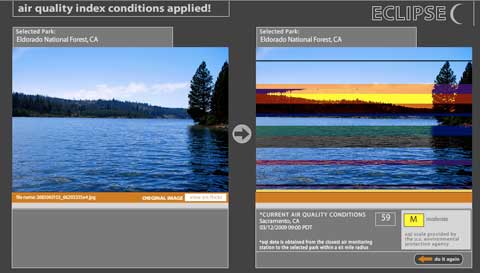
It seems I keep running into projects that attempt to visualize pollution levels. I’m not sure what intrigues me about this particular project, but I do connect with it on some level. I might just be drawn to projects which use real-time or near-real-time data. Here is a summary this project’s purpose.

Eclipse is an interactive artwork that alters and corrupts appropriated photographs of United States national and state parks based on real-time Air Quality Index readings from the web (AQI or particle pollution data is available from airnow.gov). Eclipse was commissioned by Turbulence.org and was created by Cary Peppermint and Christine Nadir, who produce ecoarttech.net.”

Tagged:

↑ up


In The Air

In the Air - a data visualization project initiated at MediaLab in Madrid

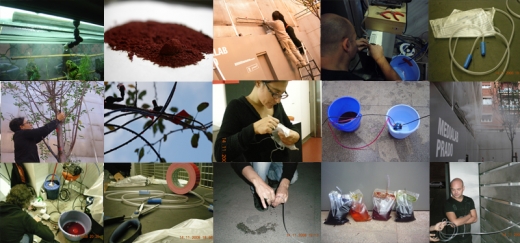
In The Air is a data visualization project initiated at MediaLab-Prado in Madrid. The project has taken a large dataset consisting of a year’s worth of air quality readings from Madrid and is beginning to realize a number of ways to make visible the invisible agents of the city’s air (gases, particles, pollen, etc). In The Air is using both web interfaces and physical prototypes for representing the data, and while the web component looks very slick, I’m considerably more interested in the physical parts.

I’m not sure how well the images read above, but those are some examples of their process as they work their way through Arduino-controlled contraptions that will spray out different colours of mist depending on the air quality data. There’s a video of one of their failed attempts on Serial Cosign, which is where I originally saw the project.

Seeing people do stuff is inspiring.

Tagged:

↑ up


Design by Sound

Sound Chair by Matthew Plummer Fernandez

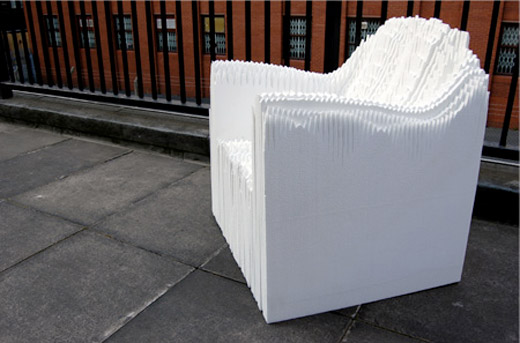
Sound/Chair by Matthew Plummer Fernandez was the result of testing 719 sounds to see which one produced the best physical object. Using 3D visualization software he wrote, Plummer Fernandez graphs the sound on a volume/time/frequency plot, thereby realizing “the beautiful and unexplored aesthetic of sound [...] a landscape of spikes and shapes that vary accordingly to the type of sound.”

Plummer Fernandez is a Royal College of Art (soon to be graduate?) and designer based in London, though I find many of his “self-initiated” projects most interesting—The Sound of Light (“A casing is made for a flourescent tube light by recording and graphing 1 second of the ‘hum’ sound produced by the light”) and Sound Tagging (“Most large buildings have distinct auditory signatures as a result of vibrations generated by traffic, underground, and wind that resonate through the solid structures”)—remind me of what I love about sound.

Tagged:

↑ up


Gapminder: Free Data + Building Understanding

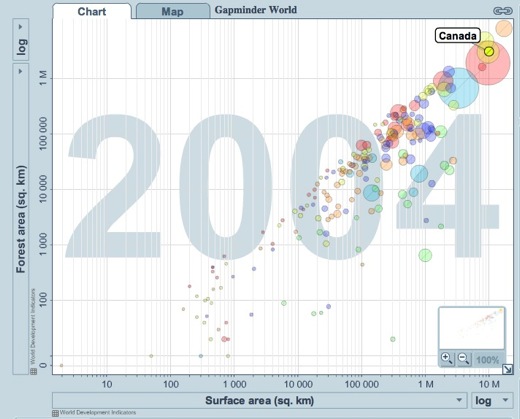
Gapminder - visualizing Canada's forested area vs surface area

I watched a TED talk sometime over the summer by Hans Roslings, in which he talked about data visualization, specifically using Gapminder. The website, Gapminder World is powered by Trendalyzer, and “enables you to explore the changing world from your own computer.” Perhaps most interesting is that the software allows you to see changes over time, seeing the way things change and the ways in which those changes are interrelated. If you visit the site, make sure to press the play button below the graph before you do anything else—it really helps to understand the possibilities of the software.

I’m very interested in trying to imagine what it would do, in terms of change, if we did have a better understanding of the way in which we and our actions are interconnected to other people and situations across the world and 20 years from now. Are graphs with moving the circles the best way to do this? I’m not sure, but I think the idea behind the tool is incredibly important.

[via]

Tagged:

↑ up


Statlab by Tjerk Stoop

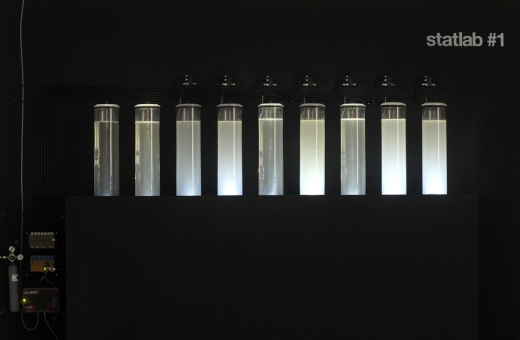
Statlab by Tjerk Stoop

Statlab by Tjerk Stoop is an environmental art project, creating an analog visualization of air quality. From Stoop’s website, “It displays the daily average of CO2 concentration trough a chemical reaction where chalk particles are formed. The result is an analogue graph where the difference in the amount of chalk particles per tank is a global measure for the fluctuating CO2 concentration within one week.” Great to see physical/analog visualization presenting important data in a clear manner (well, assuming you read the accompanying text).

[via]

Tagged:

↑ up


GOOD Magazine – Vampire Energy


GOOD Magazine has been creating a number of these short videos with great animations discussing and illustrating a variety of issues. This one, in particular, talks about “Vampire Energy,” the energy that appliances and electronics use, even if they’re in standby mode. Best practice is always to have your TV, computer, etc. connected to a power bar that can be shut off when not in use, thereby cutting the power completely.

I think the video is a good example of distributing knowledge effectively. They took existing information/data (about power consumption) and created an animation that does a better job at communicating it than a bar graph and table of numbers probably ever could.

Tagged:

↑ up


Usman Haque’s Primal Source

[NOTCOT at GLOW: Usman Haque's Primal Source from Jean Aw on Vimeo.]

As part of GLOW in Santa Monica, Usman Haque’s Primal Source was a huge interactive light/projection installation on the beach. Rear-projecting onto a water-screen, the installation responded to sound from the crowd with microphones being placed along the crowd’s edge on the beach. The event went on for 12 hours throughout the night. The software was built withProcessing and PD (an open-source cousin of Max/MSP/Jitter). 

[via] & [via]

Tagged:

↑ up


Energy

Design E2 Documentary Series

“Could it be that we are connected to all things in the universe and not the centre of it?”

Last night I saw two episodes of E2 Design on TVO. The shows are incredibly well-done, the cinematography style alone would have been enough to have me watch an hour worth of television on nearly any topic, but the fact that the show focuses on our current/historical energy crisis/solutions made it that much better. The website for the show offers downloads of each episode in podcast form, which is highly recommended. The introduction to the show, which you should immediately hear/see playing when you go to their website is inspiring and describes a mindset that I hope becomes more widespread—that we are continually making decisions that effect more people and more things than we could ever have imagined. 

Making Energy Consumption Visible via Pasta and Vinegar

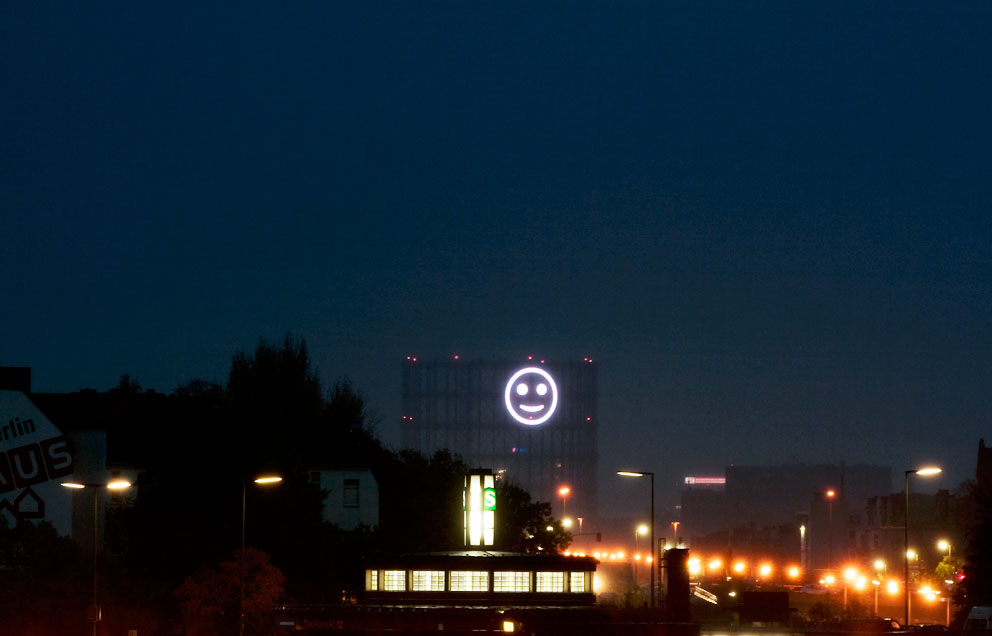
A quick entry from the always good Pasta & Vinegar highlights an instance of “revealing the invisible” in France where this large sign shows the real-time energy production of roof-top solar panels and the saved greenhouse gases. We need to be able to see, to understand, what it is we are doing by following the same consumption patterns we have for the last 25 years.

Tagged:

↑ up


Location

Windsor from Google Maps' perspective

Windsor, Ontario (South of Detroit)

SRSI: June 11 to July 11

The Storefront Residencies for Social Innovation invites the radical re-imagining of the possibilities in occupying a vacant storefront in the heart of Windsor for one month.

See the entire schedule here!!!

Mailing List


Activity

No public Twitter messages.

Follow us on Twitter

Conversations

  • Justin: I really like the distinction you pointed out between play and help. Looks like an amazingly fun time and all the better that you...
  • Rosina: yes. talk about this tomorrow/today?
  • Justin: Yeah, I think it could be very cool. You’re thinking about that lenticular rabbit you on posted on a while back as a...
  • Rosina: Serious? I would be down for it!
  • Justin: Rosina, awesome idea! The foot traffic there in both directions would really lend itself to this. Let’s do it.
  • Rosina: you know, looking at the stairs i thought a lenticular type thing would be kind of cool to see. Perhaps a two-sided message of...
  • darren: I was able to go for my usual ride to the end of Russell in the west end, thanks to the humidity finally going down a bit....
  • leesa: fantastico! i miss srsi already. congrats everyone.

Archives

Tags

3D 100 ways abandoned activism advertisements air airport algorithm Ambassador Bridge analog annotate architecture arduino art artist Artspace automobile awesome baking balloons banner banners battery BCL Bench bicycle bike bikes billboard billboards bio Blog book border brainstorm buildings bus Canada casino cellphone chalk Chattanooga cities city citynoise code collaboration collaborative collective community computer computers conference Conflux construction consultancy context costume crafts create here cross-border communication crowd-sourcing data database demo design Detroit development DIY documentary documentation downtown drawing driving ecohouse economy EC Row editing electricity electronics energy environment eric boucher event exhibition exploring extended field trip fake fashion fence fieldtrip fire firefox flagging tape font free friends gallery gambling game garbage garden gardening geography google google earth google maps graffiti grants grass green Green Corridor guerilla hack Halloween hardware history house how to HQ ice ideas image imagination Indian Road inflatable infrastructure install installation inter-city interactive internet intervention interventions interview kids Kitchener knitting LCD Lebel LED letters light lights list lists machine magnetic magnets make mapping maps materials math message michelles Michigan micro-residency mind map moss movie music nature neighbourhood news newspaper newspapers New York new york city night office hours open source opportunity paint painting paper paperwork parade park parking garage parking ticket participation party pedagogy performance perspective Peterborough photographs photography PHP pixel planning plant planters plants plastic bags pollution Portland postcards post office presentation project projection projector projects proposal psychogeography public public art public domain public realm public space pulp radio Rain reading reblog recycle remote research residency resistors reuse ribbons river roof rope Sandwich Save the City school screening sculpture sculptures security seed bombs seeds sign signage snow social practice software soldering sound Soundart space spray paint SRSI stencil stencils stickers storefront story strategic plan street street art street art submissions suburb summer surveillance sustainability sweaters tags talk tape tea technology test tetris text Text In-Transit time-lapse tools Toronto transit transmit travel tree trees tshirts tv Twitter university urban video visualization walk walking wall water Waterloo website wheat paste window Windsor wireless workshop writing youth youtube

Our Recent Research

Research Description

Broken City Lab is an interdisciplinary creative research group that tactically disrupts and engages the city, its communities, and its infrastructures to reimagine the potential for action in a collapsing post-industrial city.

Save the City

Broken City Lab: Save the City
5 months of community events to imagine how to save this city.

Subscribe

Broken City Lab RSS icon Blog RSS

Broken City Lab RSS icon Comments RSS

Events

The Storefront Residencies for Social Innovation: Launching June 11, 2010 June 11 to July 11, 2010

How to Save a City May 21, 2010 - 7pm

Open Engagement, Group Work: The Collective Impetus May 14-17, 2010

Things Worth Saving April 11 & 27th, 2010

Creative Cities Summit: Using Art to Change Cities in Lexington, Kentucky Apr 7-9, 2010

» More Events...

Cross-Border Communication

Cross-Border Communication: We're In This Together
Cross-Border Communication is an interventionist performance series based on the desperate need to communicate with Detroit from Windsor.

Most Read Posts

Contact

info@brokencitylab.org

Bookmarks

What We're Reading

Links

Meta