Hello. We're artists working through collaborative social practice and creative research to understand the ways in which locality is shaped and enacted in the city.
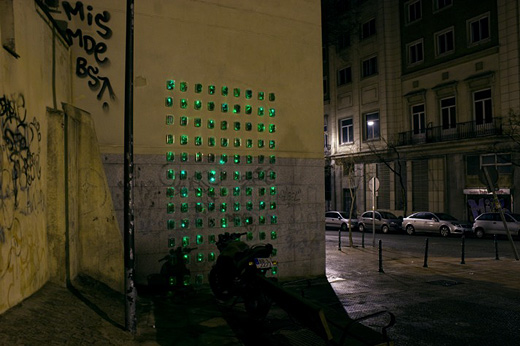
Luzinterruptus is a Madrid-based light art intervention collective. They’ve done some really large-scale works in streets around the world, this project, Garden for a not too distant future, being one of their most recent.
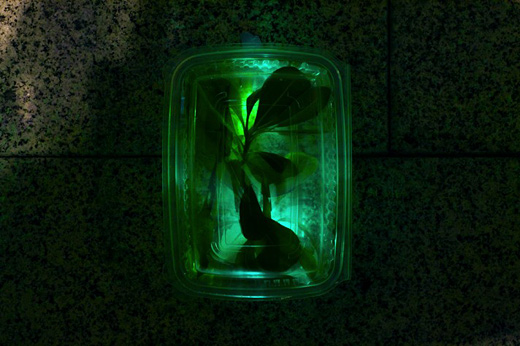
From their site, “For this installation we used 110 transparent food packaging containers, inside which we put leaves and branches found in the trees in the area and lights of course. Afterwards, we placed them on a wall in an ugly square in the center of Madrid and there we left our form of fashionable vertical garden.”
The work critiques the arguably impractical value of vertical gardens in public spaces, with the collective stating, “… if we continue to eradicate it from public spaces or reducing it to inaccessible vertical faces, the only form of contact with nature will be in supermarket refrigerators, packaged with expiry dates.”
I suppose what I find most interesting about their work is the relentless necessity to encounter it at night — and that they insist on working in the context of outdoor space. According to an interview on UrbanArtCore, they head out nearly once a week to create an installation; here’s hoping summer gives us that kind of time.
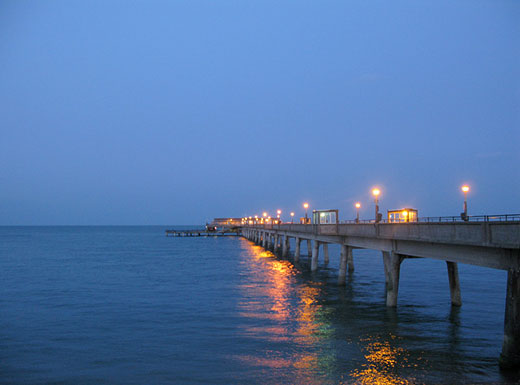
At any one time there are around 6000 lightning storms happening across the world, amounting to some 16 million storms each year. Such dizzying statistics are useful to hold in mind while experiencing Streetlight Storm, a new artwork by Katie Paterson.
Paterson’s work often deals with the translation of experiences of nature to representations of nature. I quite enjoy projects like this that visualize the complexities of data from the natural world in quiet, simple ways, as previously noted.
Be warned, the music kind of destroys this video. At any rate, for one month on Deal Pier in Kent, during the hours of darkness, the pier lamps will flicker in time with lightning strikes happening live in different parts of the world.
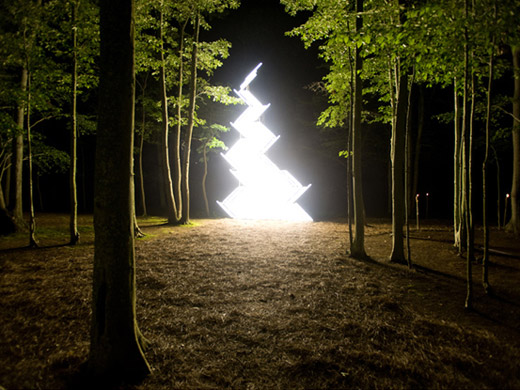
Here’s a really beautiful work, Eclipse done with fluorescent lights by the Israeli artist, Yochai Matos. Along with light installations, he also does some interesting street art that deal with highlighting perspective, glitter, and 8-bit aesthetics.
I know when we were up in Peterborough, I had wanted to work with fluorescent lights, but from the little research I did, it seemed prohibitively expensive. Does anyone have any insight they could share on how one might work with these lights in this way, maybe specifically—does each light need a ballast, or is there a way of wiring in parallel that can get around that?
SWEATSHOPPE is a new multimedia performance collaboration between Bruno Levy and Blake Shaw that works at the intersection of art, music and technology. Their project, Light Painting, is pretty slick, using a LED-tipped paint roller along with some custom software and projector to reveal a video projection through painting movements.
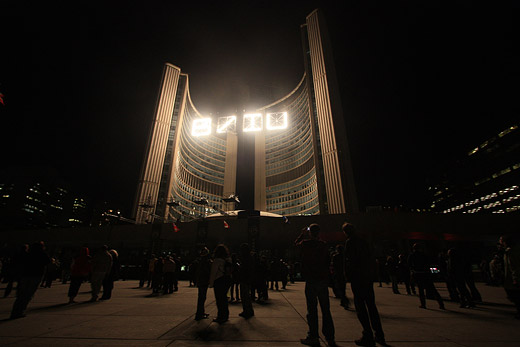
4 LETTER WORD MACHINE is a giant illuminated computer-controlled / live performance text display by artist, David Therrien.
Recently exhibited at part of Nuit Blanche this past Saturday attached to Toronto’s city hall, the installation displays “the phenomema of light and electricity and the role of light in our belief systems, language, biology, natural world and cosmology -- light as illumination, energy, information -- and as a metaphor for good and evil.”
Guess how much I’d love to be able to work with something at this scale.
Ignore the music in this video, but watch the work come together in Scottsdale back in January 09.
In the meantime, we’ll keep collecting images and reference points about ways of imagining the project happening.
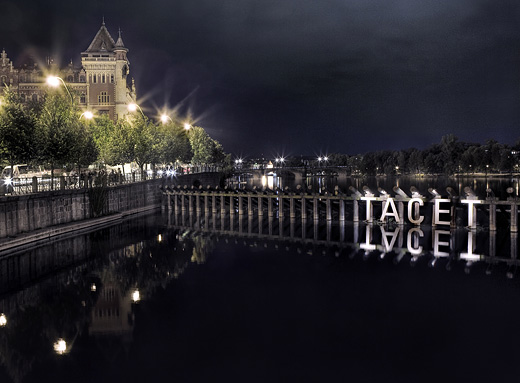
Above is TACET by Ulla Rauter, which refers to acoustic pauses by drawing on the urban background noise making it the unwritten score of that piece of art. There’s something about instructive text that I quite enjoy.
Josh wrote about the LightLane project a while back, and skepticism aside, it seems as though the idea is finally moving beyond just the proposal stage. The video above is essentially a proof-of-concept, but very exciting.
Looks to me like you need to ride really, really fast to get the trailing effect.
After meeting with Massey’s Junior Physics Club again today and then discussing that project further at tonight’s Office Hours, trying to figure out exactly what we need to do to make a really large-scale projection happen, I saw this video on Jenny Holzer’s latest Projection for Chicago, as part of her ongoing Xenon Projections series.
Check out the size of her projector near the beginning—insanely huge, but also insanely bright.
Now wouldn’t this be a good idea for some of Lebel’s windowless rooms? This light transmitting concrete was developed in 2004 and is called LitraCon. I’m not having a very easy time thinking of many applications for this recent invention, but I’m sure it could save on lighting costs for rooms in which activities would be carried out during the day.
“Litracon is a combination of optical fibers and fine concrete. The glass fibers lead light by points between the two sides of the blocks. Because of their parallel position, the light-information on the brighter side of such a wall appears unchanged on the darker side. The most interesting form of this phenomenon is probably the sharp display of shadows on the opposing side of the wall. Moreover, the colour of the light also remains the same.”
By Joshua Babcock on February 13th, 2009, 2:55 pm 4 Comments
In anticipation of a time when we will feel comfortable in long-sleeved shirts, I’ve revisited an early BCL discovery: bicycle safety using light! While I’m not too sure how we could use lasers to create images, I have no doubts that we could use them for a handful of other Windsor-related projects. If this “Light Lane” concept becomes a reality, and people do not abuse it, it could prove to be a cost-effective way of keeping cyclists spatially segregated from motorists.
The Light Lane‘s creators, Alex Tee and Evan Gant, describe the project as such: “Our system projects a crisply defined virtual bike lane onto pavement, using a laser, providing the driver with a familiar boundary to avoid. With a wider margin of safety, bikers will regain their confidence to ride at night, making the bike a more viable commuting alternative.”