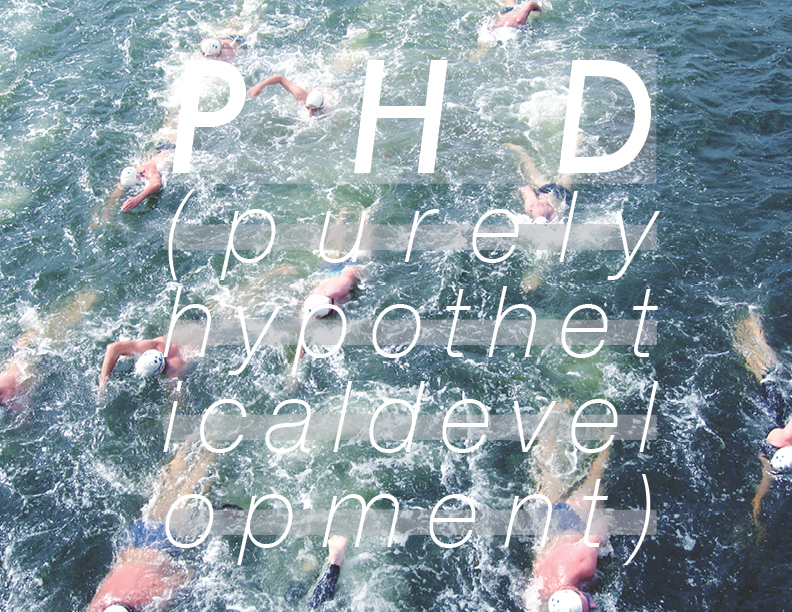
While we are busy ironing out the details of our final project at CIVIC Space (more details on this soon), we are pleased to announce a smaller interstitial project called PHD, standing for Purely Hypothetical Development.
The idea for PHD came out of a conversation we had over a coffee one afternoon around art and education, and whether one necessarily needs the other or not. Is a post-secondary institution the appropriate place to develop an art practice, or is it really just all hypothetical, or worse yet, is it even hypothetical enough?
So, in the spirit of experimentation and inquiry, we are launching PHD, a two week program where we invite four participants (the boundaries are intentionally vague here) to work at CIVIC Space during the first two weeks of March. Together these people will explore ideas, trajectories of thought, impossibilities, margins, peculiarities, relationships, and they will share their findings with the others working in the space. The developments will be hypothetical; there might not be outcomes, but this brief burst of concentrated thinking is bound to produce something unexpected.
Participants at the end of this program will present their ideas and earn their “PHD”.
Applications are open. Those interested in participating in PHD can email Sara Howie at sara[at]brokencitylab[dot]org or click on the link above. Please include your name, a brief description of a project you would like to hypothetically develop, and a little bit about your interests.
Applications close February 28th and those chosen will be informed shortly afterwords.
We’re less than two months away from Homework II: Long Forms / Short Utopias and things are really coming together. If you’ve been browsing our site lately, you’ve probably seen that we have announced a tentative schedule for the weekend and a list of people who will be curating and sitting on panels. While things might change slightly in the next two months, the schedule is an accurate representation of how the weekend will go, more or less. We’re very excited and we hope you can attend Homework II this fall. For more information and to register to attend, please click here.
Jeanne van Heeswijk is one of three featured keynote speakers who will be presenting at Homework II. Currently living in Rotterdam, she is a visual artist who, since 1993, has created contexts for interaction in public spaces. Her projects distinguish themselves through a strong social involvement. She creates new public (meeting-)spaces or remodels existing ones with her work.
She regularly lectures on topics such as urban renewal, participation and cultural production and sees herself as a mediator, an intermediary between a situation, a space, a neighbourhood and the people connected to these. She has coined the term “urban curating” for her interventions and “in the sedate Dutch art world in which all taboos appear to have been broken, her work – uniquely – arouses fierce controversy.” Jeanne will be speaking with these ideas in mind and, along with Steve Lambert and Darren O’Donnell, will be presenting on the first evening of Homework II (Friday, November 8th).
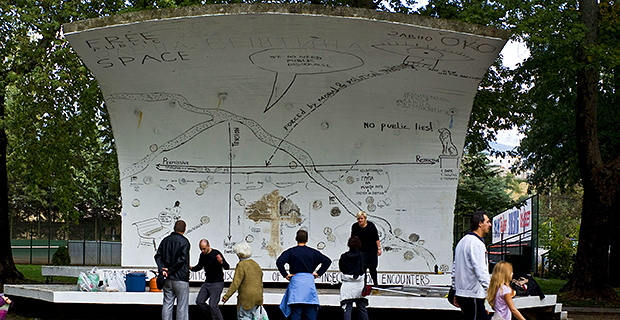
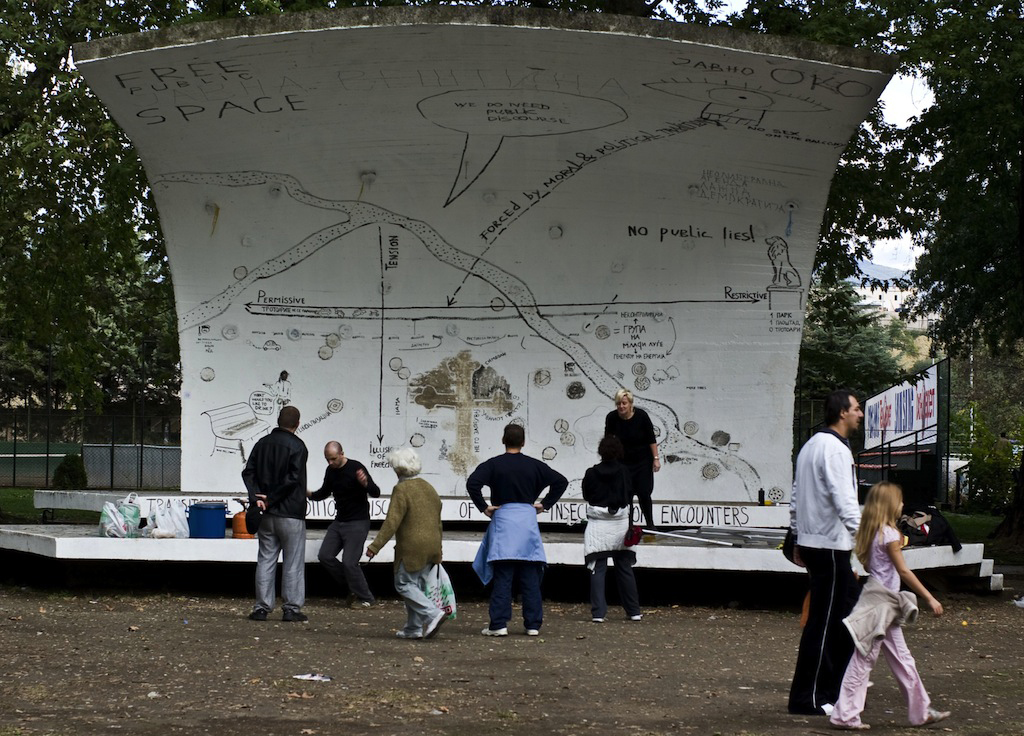
Jeanne van Heeswijk – Public Faculty (2008-2012)
Public Faculty No. 1 – Skopje City Park (2008)
“Public Faculty, which has previously taken place in Macedonia, the Netherlands, Serbia and England, refers to Joseph Beuys’s epochmaking work ’Richtkräfte’, an installation with 100 blackboards created for public discussion. The idea is to engage in learning by means of exchanging knowledge in a certain locality. By visualizing the discourses, the signs set a rethinking of the public arena in motion through collective cultural action. Driven by a belief in the connection between art, life and space, she engages herself in local communities and involves the public in social projects with communication and change as the objective.”
Homework II will run November 8-10, 2013 in Windsor, Ontario at Art Gallery of Windsor and CIVIC Space.
Our featured keynote speakers this year will be Jeanne van Heeswijk(Rotterdam), Darren O’Donnell(Toronto), and Steve Lambert (New York). In addition to our keynotes, we’ve also invited a series of curatorial partners, who we’ll be announcing soon, to develop panels that tackle the conference themes. And, to top it all off, everyone who attends will be co-authors of a book that captures the ideas and conversations from this year’s conference through a series of interviews with presenters, attendees, and organizers alongside collected materials from our 2011 conference.
Next in the Neighbourhood Spaces (NS) mini-doc series is an interview with artist-in-residence Ariana Jacob. She has been staying with us at CIVIC Space for the past month, and we’ve been lucky enough to catch occasional glimpses into the work she’s been doing. As a Neighbourhood Spaces artist-in-residence, Ariana has been based in Windsor’s Unemployed Help Centre and Tecumseh Mall. She has also been having conversations with the people she encounters on the streets, sidewalks and in transit as she travels from downtown Windsor to her community sites by bus. She has also made a series of great silkscreened posters that you may have seen on our blog or around town.
Currently living in Portland, OR, Ariana makes artwork that uses conversation as medium and as a subjective research method. WORKING / NOT WORKING explores the basic realities of what people do for work these days, the place work has in their lives, and how contemporary work and economic realities are affecting how we understand ourselves.
Drawing on Studs Terkel’s classic book, “Working” this project revisits his approach to the role work has in our lives considering how much more precarious work conditions have become since Stud’s 1970s.
For some artists, the systematic self-criticism of art meant autonomy-as-a-value comes to stand for something other than the production of art objects. The working role of the ‘artist’ is thrown into crisis. Avant-gardes often did not conceive of themselves as a vanguard of artists leading the way, but as artists refusing the role of artists.
Danielle, Michelle and I were over in Detroit at the recent INITIATE panel discussion and Evan Roth made a presentation on the early stages of some of this work. It’s awesome to see where it went — hopefully we’ll have a chance to head over and check out the show. Here’s the details from Roths’ site…
Eastern Michigan University’s University Gallery 900 Oakwood Street, 2nd Floor
Ypsilanti, MI 48197
Reception @ EMU’s University Gallery October 14, 4:30pm – 7:00pm
March 8, 2012: It is no secret that Detroit’s creative community has been attracting media attention of late. What started as photos of “Ruin Porn” and “$100 Dollar Houses” led to a flood of additional articles on creative activity in Detroit.
Evan Roth’s exhibition, Welcome to Detroit, will feature nearly all-new work, much of it made during his residency. The work follows his core conceptual framework of appropriating popular culture and combining it with a hacker’s philosophy to highlight how small shifts in visualization can allow us to see our environment with new eyes, whether online, at home, in the city or at the airport. His work acts as both a mirror and vault to contemporary society, creating work that reflects and withstands a world of rapid advancements in computing power, changing screen resolution and repainted city walls.
For Welcome to Detroit, Evan mines everything from the spray paint can, to hip-hop music, to airplane shopping magazines and flight safety cards, resulting in a show that moves freely across media, but always with a sense of pop cultural pranksterism. From individual art objects to video pieces to documentation, the work is designed to simultaneously serve as a record of activity and creative output, while also underscoring important issues concerning copyright, public space, and our offline and online identities.
Hi, 5 (5 Questions) is a web-only interview series which presents five questions to artists, activists, and creative thinkers alike. The project acts as an educational device which allows us to gain insight into the narratives that define successful individuals. We are interested in the motivations behind ambitious ideas and how these individuals chart personal change in relation to their surroundings.
About David Spriggs
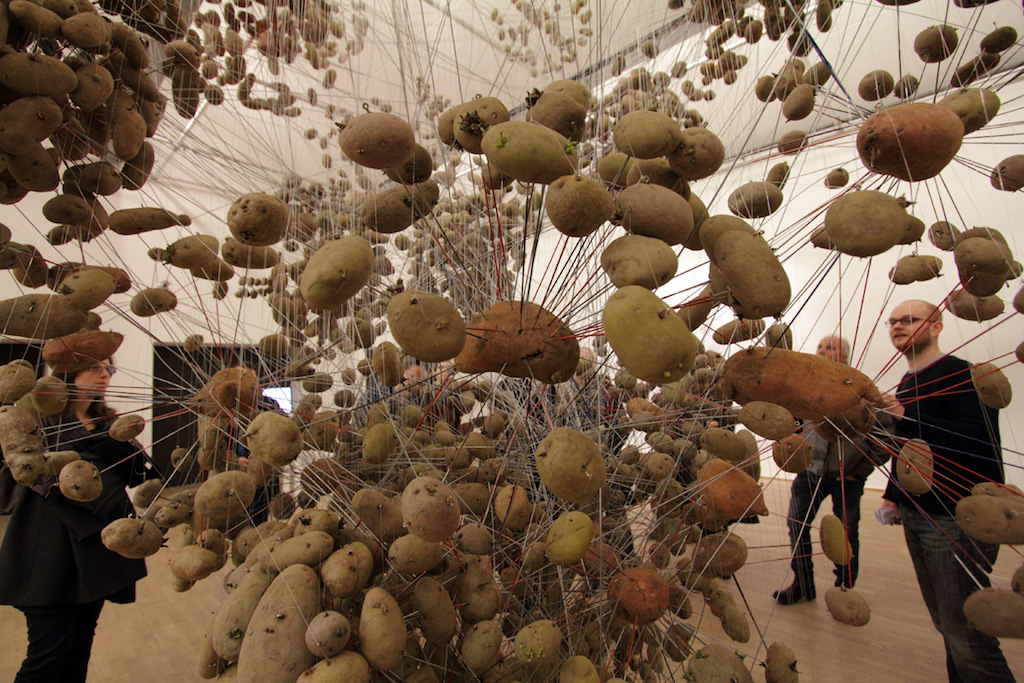
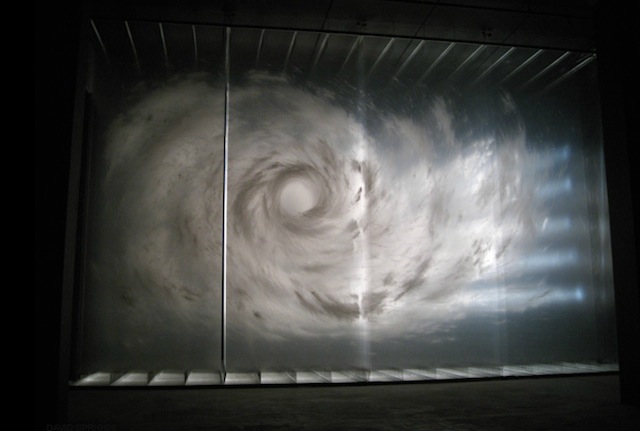
David Spriggs explores the representation and strategies of power, the symbolic meanings of colour, and the thresholds of form and perception. His installation based work lies in a space between the 2 and 3 dimensions. In many installations he uses a technique he developed in 1999 using multiple painted layered images in space to create unique ephemeral like forms. The subjects depicted in his work relate to the breakdown and recreation of form and volume – as seen through his interest in cyclones, explosions, and forces.
David Spriggs is currently based in Montreal. He was born in 1978 in Manchester, England, and immigrated to Canada in 1992. He received his Master of Fine Arts from Concordia University, Montreal, and his Bachelor of Fine Arts from Emily Carr University in Vancouver.
David Spriggs - Axis of Power (2009)
David Spriggs
February 19/2012
If you had to describe your current self to a 16-year-old you, what would you say?
I am a contemporary artist working primarily on installation based work.
Could you describe an evolution in your work or way of thinking?
I have been through many different styles in my life as an artist. I tried everything to find out what works and what doesn’t. My thinking has lead from concept to another. 12 years ago I started thinking about transparency, then about 8 years ago concepts around the immaterial and perception, and more recently on concepts of power and the symbolic notions of colour.
Are there any people who have been instrumental in the development of your way of thinking and viewing the world?
The theories of the Futurists and Cubists have been interesting to me. I have been perhaps most inspired by writers such as Baudrillard, Virilio, and Foucault.
How do your political beliefs inform or fuel your work as an artist?
I would say that it is not so much political beliefs as much as being informed about the world, the general news, and advancements in science and theory.
What do you feel a city should be or do for its inhabitants?
A city is a changing organism that keeps it’s community alive. I would like to think culturally that a city provides its citizens a network in which the arts can flourish.
The incredible weather has me getting excited for the summer, and in the process, thinking back to our past couple of summers, and imaging the summer ahead. I recalled the city workers strike back in 2009 and it reminded me of the work of Mierle Laderman Ukeles, and I thought it was long past due that I post about her work.
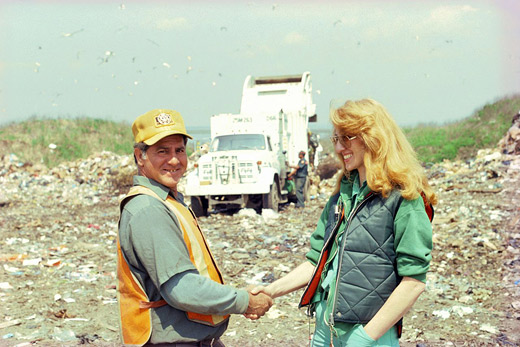
From the description at the Ronald Feldman Gallery, Ukeles spent eleven months from mid-1979 to 1980 creating Touch Sanitation, a public performance art work. She crisscrossed New York City ten times to reach all fifty-nine sanitation districts to face, shake hands with and thank every sanitation worker for “keeping New York City alive.”
And as noted over at the Green Museum, Touch Sanitation was Ukeles’ first project as the city’s new artist-in-residence […] Ukeles traveled sections of New York City to shake the hands of over 8500 sanitation employees or “sanmen” during a year-long performance. She documented her activities on a map, meticulously recording her conversations with the workers.
At the conclusion of the performance she was made Honorary Deputy Commissioner of Sanitation and also Honorary Teamster Member of Local 831, United Sanitationmen’s Association, and I believe she’s been an artist in residence there ever since.
Also worth checking out — her Manifesto for Maintenance Art 1969. After child-birth in 1968, Ukeles became a mother/maintenance worker and fell out of the picture of the avant-garde. In a rage, she wrote the Manifesto for Maintenance Art 1969, applied equally to the home, all kinds of service work, the urban environment, and the sustenance of the earth itself. She viewed the Manifesto as “a world vision and a call for revolution for the workers of survival who could, if organized, reshape the world.”
This is the kind of work that makes me want to make more art.
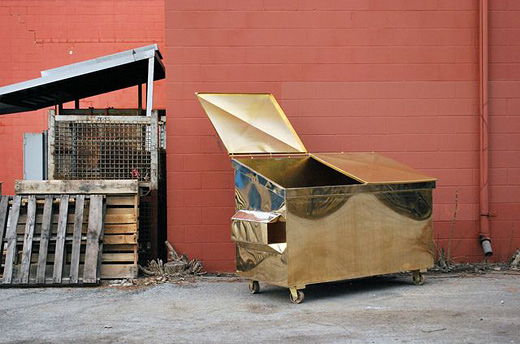
Zeke Moores makes badass metal sculptures from metal. He does this in Windsor; we’re lucky to have him (and his partner, Lucy, who we’ve written about before) in this city.
He has an extensive background in metal fabrication and working in a foundry, and he teaches at the University of Windsor. His work explores the social and cultural economies of everyday objects, and in particular, his Bronze Dumpster is going to be testing some of those economies as it slowly travels to alleyways across the city over the course of the summer.
Hopefully we’ll get to play with Zeke and Lucy sometime soon.
This one goes out to Josh, our resident wood worker.
Steve Lambert on video making his latest work, 98.5%. From his vimeo page, “While this video only takes three and a half minutes, the actual sign took several days to make. Victoria Estok and Kyle Hittmeier helped along the way – Kyle can be seen painting, Victoria is more elusive. The soundtrack is from some old friends.”
David Rokeby is a Canadian artist who worked for years in new media, creating interactive installations, and exhibiting them around the world (including here in Windsor most recently at the 2008 Media City -curated AGW exhibition). I had the opportunity to work with him on that 2008 show, Plotting Against Time, and he is one of the nicest and most brilliant people I’ve ever met.
More recently, his work has turned to large-scale installations. 2007’s Cloud played with perception through small sculptural elements rotating under a computer’s control.
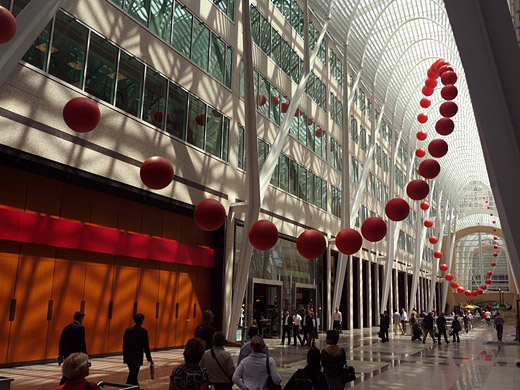
This year’s long wave is a site specific installation that was commissioned by Luminato, Toronto Festival of Arts + Creativity and was on view at the Allen Lambert Galleria, Brookfield Place, Toronto, June 5 – 20, 2009. It is a 380 foot long, 60 foot high sculpture tracing a helix through the entire length of the galleria.
“long wave” is a materialization of a radio wave, a normally invisible, but constantly present feature of environment. It represents the length of a radio wave in the short-wave radio band, in between the sizes of AM and FM radio waves. In our contemporary wireless environment, populated by tiny centimeter long wifi transmissions, these radio waves are really the dinosaurs of our communications era.
I’m getting more and more interested in larger-scale installations like this that at least in part respond to the architecture in which they are situated. With so many vacant building across this city, why worry about a sculpture garden when we could have an “installations in abandoned factories” tour?