Hello. We're artists working through collaborative social practice and creative research to understand the ways in which locality is shaped and enacted in the city.
kanarinka is a new media artist whose research interests include the politics of digital information, feminist performance art, participatory culture and the emotional landscape of Homeland Insecurity. She is Co-Founder of the non-profit collective iKatun, a founding member of the Institute for Infinitely Small Things, and teaches at RISD’s Digital+Media Graduate Program and the School of the Museum of Fine Arts in Boston.
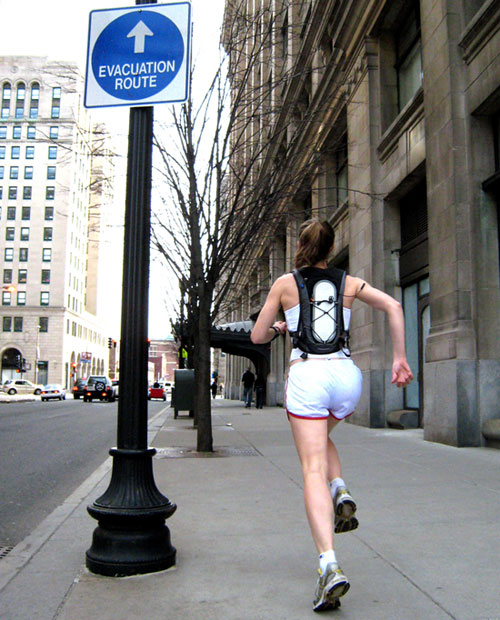
In Spring 2007, kanarinka ran the entire evacuation route system in Boston and measured its distance in breaths. The project is an attempt to measure our post-9/11 collective fear in the individual breaths that it takes to traverse these new geographies of insecurity.
The $827,500 Boston emergency evacuation system was installed in 2006 to demonstrate the city’s preparedness for evacuating people in snowstorms, hurricanes, infrastructure failures, fires and/or terrorist attacks.
It takes 154,000 breaths to evacuate Boston consists of a series of running performances in public space (2007), a web podcast of breaths (2007), and a gallery installation of the archive of breaths (2008). There’s also an online collection of podcasts, with audio recordings made during each running performance.
The work is being shown as a part of Experimental Geography, an exhibition that explores the distinctions between geographical study and artistic experience of the earth. I picked up the book from this traveling exhibition a while ago and it’s an interesting read. There’s some inspiring work, but as is often the case with these kind of collection books, the introduction is far more enlightening than many of the preceding chapters.
What I like about this project is the physical translation of a kind of bureaucracy along with the gesture of exploration through so much of the city under the restrictions of urgency and evacuation. It makes me want to imagine ways for exploring bureaucracies of Windsor.
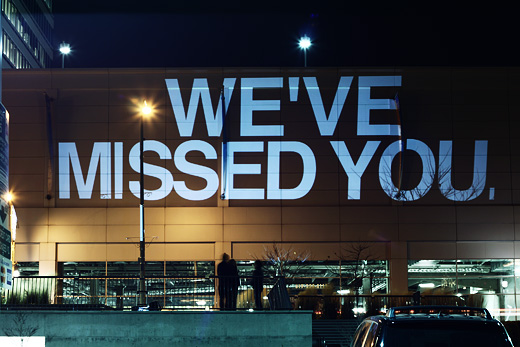
Last night was the second iteration of Cross-Border Communication where we sent a variety of messages from Windsor to Detroit. We started with “We’ve Missed You.”
We’ll be doing the final iteration of this suite of Cross-Border Communication tonight (Wednesday) around the usual time (8pm).
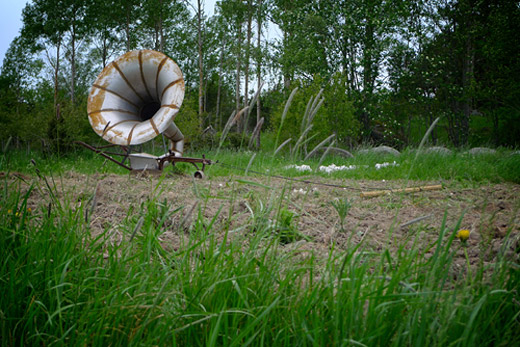
This is the Terrafon, which is basically a huge turntable for the earth. Designed by artists Olle Cornéer and Martin Lübcke, the Terrafon premiered at the Volt Music Festival in Sweden.
The sound of the Terrafon is pretty much what you’d expect from something being dragged across the ground. The video does a good job at capturing the variations in sound, but mostly it’s the sounds of rocks or gravel being rubbed against something. It reminds me of when I was a kid and would drag things behind my bike.
The look of this thing is very cool and made me think of other ways to use something like this, rather than necessarily making it performative, what if there was something large and industrial-looking like this installed along the river, or at the entrance to old industrial buildings, what sounds would it make?
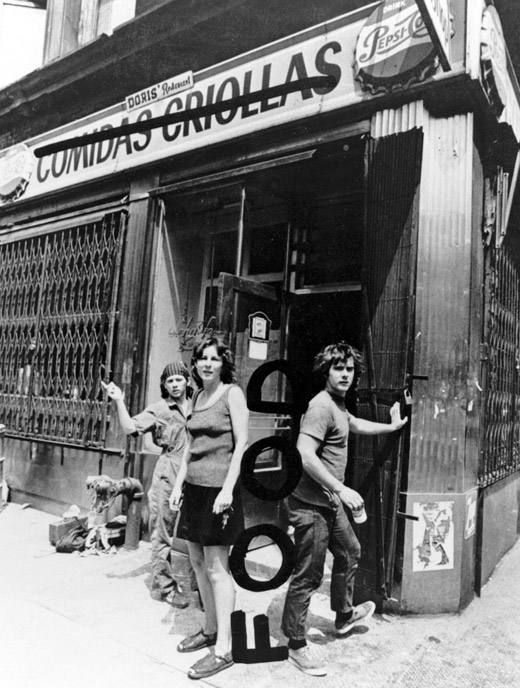
Carol Goodden and Gordon Matta-Clark opened up Food in New York in the early 1970s on the corner of Prince and Wooster. The restaurant, essentially the first in SoHo, was run by artists and served mostly artists, with the cooking itself becoming a performance of sorts. This transition of the space from a failed Puerto Rican restaurant to Food’s occupation to an alternative space that functioned as and questioned art and the potential in economic models based on something other than profit growth.
Established as a kind of “perpetual dinner party”, the restaurant as an idea was the art, alongside the actual dishes served up, the design, and the performance of cooking. Conceptually that’s important, but what’s really becomes interesting is the idea to open a place that wasn’t founded on profit, and indeed collapsed in some ways because of that. However, certainly that’s not the point.
Creating an idea with a sunset date, or with an acceptance of failure from the start, allows for a focus on the things beyond regular concerns. In the case of Food, artists stood in as guest chefs, inedible food was served, a hub of activity was created, and whether or not it succeeded, and indeed eve the tools with which one could measure the success or lack thereof, became irrelevant.
So, what if the next idea you have came along with a self-imposed sunset date? How would you work differently? What would become a priority and what would fade into the background? Tom’s recent post on the not-for-profit restaurant in Windsor, Namaste, invites similar questions and provides some encouraging answers.
I would be remiss if I didn’t also quickly mention Matta-Clark’s significant architectural interventions, again something deserving of its own post, eventually. His “building cuts” works in some ways paralleled the thinking behind an initiative like Food, in the case of these large-scale architectural works though, the question became, what if walls didn’t matter?
A few hours before we were set to do the 100 Ways to Save the City project, we decided we wanted to make it interactive in some way. I had gone ahead and put all of our ideas on how we might suggest saving the city into a nice Keynote presentation that we could easily play and have that project, but it really limited what the projection could be.
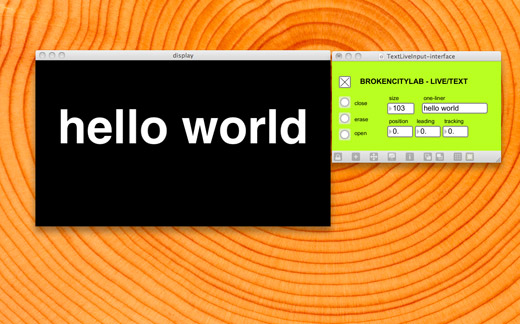
When it came down to actually figuring out how exactly to do this though, we were a bit unsure. There was nothing that I could think of that would do this fairly simple thing we wanted: input controls for basically just text on the laptop screen, and then displaying the resulting text on the projector. So, I went searching through old project files from Quartz Composer, Processing, and Max/MSP/Jitter.
It’s been a while since I’ve worked in any of those programs, and so I was a bit rusty. I knew that I had seen something like this before, and it seemed to me that somewhere I had already hacked together the exact thing we needed. I found the Max patch that detected the dominant colour in a video signal and then overlayed the word on the video (for example, Red), dynamically resizing the text depending on the intensity of that colour, which seemed hopeful, but ultimately didn’t have any manual input.
Finally, I found what I was looking for. It was based on a tutorial on Cycling74‘s website, meant to be dynamic subtitling or something like that. I downloaded the tutorial, changed what I needed and it worked for our performance. Since then, I’ve cleaned it up, got rid of the live video part we didn’t need and simplified the functionality. This was probably the first time that I was in a situation that proved Max/MSP/Jitter’s strengths—quick prototyping, troubleshooting, finessing that ca quickly lead to performance. If you have Max 5, you can download the patch, I’m not sure if it works with 4.6.
This might come in handy this week, depending on what we take on in Peterborough.
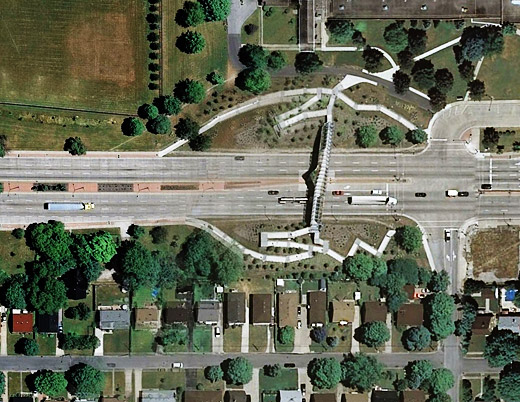
TODAY in Windsor, there’s an incredible amount of activity happening. The Green Corridor will host a talk / workshop from Ontario Arts Council and Canada Council grant officers, two artist performances, and one huge outdoor event to bring culture to the NAFTA freeway.
Lee Rodney will launch her Border Bookmobile—a Windsor-made 1993 Plymouth Voyager stocked with a collection of artist books, theoretical texts, maps, and ephemera about the urban history of the Windsor-Detroit region and other border cities around the world.
Jennifer Willet will conduct ongoing laboratory research and hold a bio-art workshop with the general public in the presentation of her work InsideOut: Laboratory Ecologies. This piece explores the laboratory removed from its sterilized artificial setting and placed in an outside world full of environmental organisms and ecologies.
The Green Corridor along with composer Brent Lee, visual artist Sigi Torinus, Assumption High School musicians, What Seas What Shores, CJAM 91.5fm, and others will create a one-hour performance of music and visuals that interact with the passing traffic on Huron Church Road near the Pedestrian Overpass. Drivers can tune-in to the performance in near-realtime and contribute to the Drive-Thru Symphony by honking their horns, or revving their engines, or generally making noise. Broken City Lab will also be contributing through a number of projects by us as individuals.
Here’s the schedule:
1:00 – 2:30 – Canada Council and Ontario Arts Council
Integrated Arts Programs Information Session
Room 115 LeBel Building, University of Windsor
3:00 – 6:00 – Border Bookmobile, Lee Rodney
InsideOut: Labratory Ecologies, Jennifer Willet
8:00 – 9:30 – Drive thru Sympony Performance
Nature Bridge Pedestrian Overpass,
Huron Church Rd. at Millen St.
1:00 – 2:30 – Canada Council and Ontario Arts Council / Integrated Arts Programs Information Session / Room 115 LeBel Building, University of Windsor
3:00 – 6:00 – Border Bookmobile, Lee Rodney / InsideOut: Labratory Ecologies, Jennifer Willet
8:00 – 9:30 – Drive thru Sympony Performance / Nature Bridge Pedestrian Overpass / Huron Church Rd. at Millen St.
This is going to be an amazing event, dare I say, history-making. You need to be there.
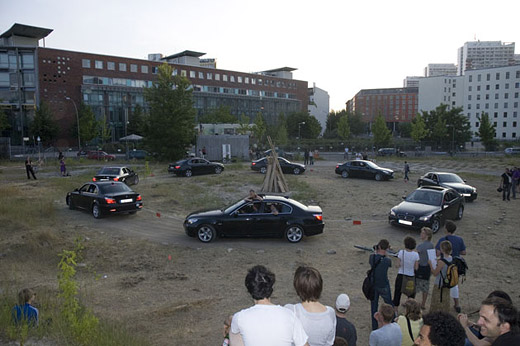
In a vacant lot of downtown real estate in Berlin, eight BMWs drove around in a perfect circle roped together like a carousel, while “This Land Is Your Land” by Woody Guthrie is playing on their radios – remixed for an amusement ride sensation. Every couple rounds the drivers systematically stop to pick-up and drop-off spectators and riders. Just before dusk, a fire is lit inside the circle.
The project, which was part of the 5th Berlin Biennial and sponsored by BMW put the sponsorship and the spectators themselves on display in a lot destined for more high-end development.
Maybe the reverse of this—that is, rusting and broken down domestic cars being pushed in a circle on a vacant lot in the west-end, might be fun … or even more offensive.
As part of their sixth annual MP3 Experiment, Improv Everywhere used Roosevelt Island, situated in between Manhattan and Queens on the East River.
To participate in this year’s experiment, “agents” were given these instructions. Everyone synchronized their watch to the clock on the instruction page, downloaded the mp3, wore a red, blue, yellow, or green shirt, and then traveled to the island. At exactly 4:00 PM, everyone would press play from wherever they happened to be on the island.
Another amazingly fun gesture from Improv Everywhere, with the scale of this “mission” being particularly incredible.
Public Sculpture Tackle rethinks interaction with public sculpture. Performed by the Bruce High Quality Foundation, the work is pretty much what it sounds like; artists in the BHQF wear makeshift-athletic gear and attempt to tackle public sculptures in Manhattan, which is, by nature, “on the defense.”
I keep thinking about what public sculpture looks like in Windsor and wondering about what it means to have a sculpture ghetto garden. Public sculpture should be integrated into the streets.